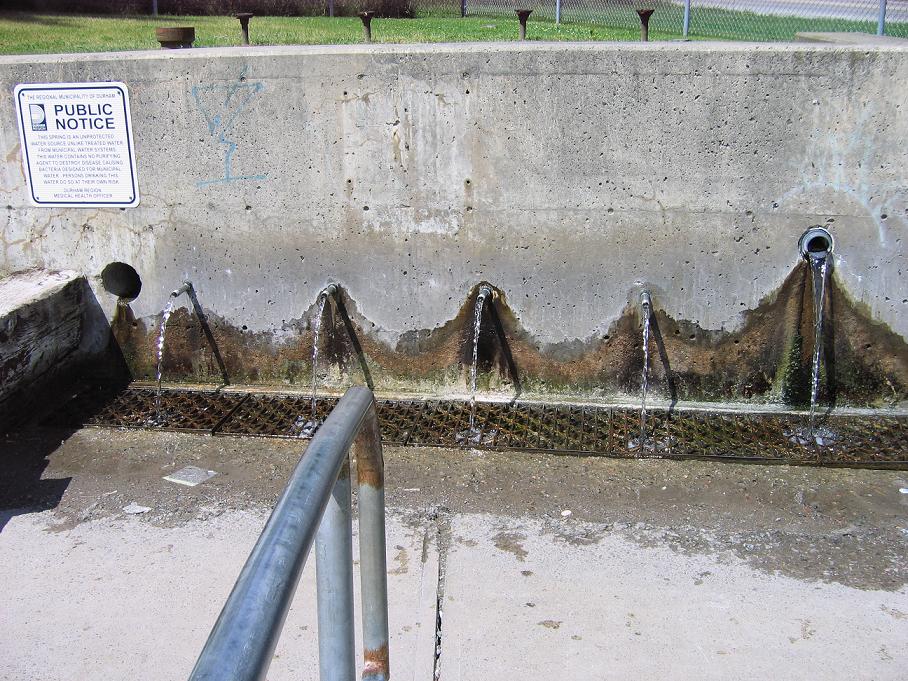
it simply implies that- “not intended” Local de-facto government is just covering their ass should some un-expected situation come about that someone gets sick. Too bad that life, we don’t need a nanny state government.
Our family has been drinking from this spring for almost 10 years. Best spring in Ontario. Since moving to Peterborough I make the trip when visiting clients at least once a month. it’s worth the drive!
I used to get water years ago when this spring was on the other side of Lakeridge Rd. I met a Ministry worker there one day when he was testing the water, He Years ago when this spring was on the other side of Lakeridge Rd I met a Ministry worker testing the water. He asked me if I ever got water in the spring to which I answered no, only in the summer and fall. He said in the spring, runoff from the snow as well as particles in the air could contaminate the water
Again regarding the test results taken earlier in 2018, take this with a grain of salt. They are strictly a snapshot of the results. Only a regular monitoring and sampling program can determine if any ground water contamination has taken place from the documented and undocumented landfill sites that are in proximity of the spring in the moraine. As a safeguard, filter the water with a conventional activated charcoal filter system (heavy metals, chlorinated products etc. will be removed, but most of the mineral content will still be in the filtered water). I do water sampling and analysis as part of my job and I’m speaking from experience.
Hi all! I would like to perform a lab test on the water and I was wondering if anyone would be interested in chipping in to get results. If you are interested please email me at chalklake2024@gmail.com
I have been to the spring as recently as 2 days ago and I noticed new signs saying the water is not fit for human consumption. Does
anyone have any info on this ? Nov 23,2021. Anyone know the stratus of this spring?
I would caution on depending on the recent lab testing done in April 2018 for definitive results. The April testing covered only a small snapshot in terms of time and only a small list of parameters from the Ontario Water Drinking Objectives Regulation 169/03.
To quality the water as drinkable, regular testing is needed against the parameters in Regulation 169/03. The testing would be expensive which is why Durham Region doesn’t test and posted a sign warning of the risks.
Given the known landfills which have contaminated fill further up the Moraine and the unknown areas where contaminated fill could have been dump, I’d put the water through a filter (at least a decent activated charcoal filter if not a multi-stage filter), to lower the risks.
One thing I notice is how many of you are concerned about the water being frequently tested yet u all go back for more without the test results… Water makes up 99% of who we are and we need it to survive. And people are collecting it from an iron pipe in a concrete block and thinking it’s the best water around? I understand that it’s probably better in some ways then tap water or even most bottled water considering the restrictions for our drinking water are so weak I can run toilet water through a Brita and bottle it and sell it having people think it’s natural filtered water and legally get away with it. Quit being cheap and find a corner store with an reverse osmosis system to fill your 5 gallon jugs. The happy market here where I live even has one.so u gotta pay a couple bucks big whoop. Saves u the gas money and puts it toward properly filtered drinking water. Safe drinking water should have a tds value of under 10ppm. And a ph of 7. No higher and no lower especially by drastic amounts. All that excess shit in the water that makes up a high tds value has to be now filtered through your kidney and liver. (Instead of an reverse osmosis machine) your body trys to filter it so you have pure water to hydrate with… Water filters have tonne changed over time. Why arnt u caring about your own internal organs that filter the water. Think those are more robust then the water filters u can buy in stores? Doubt it. All that shit doesn’t come out in your pee i can guarantee that… especially hard metals and byproducts in the water. Alot of that goes straight to ur brain. Main cause of ALOT of disorders and diseases that affect you in a long term way and shows up when you are old. People shouldn’t be dieing in their 70s or losing their minds and forgetting their families at that age… maybe all the bullshit gunked up over years of unhealthy water and food and air is the cause… well we know it’s the cause for the most part… start educating urself on what u need to survive as a human being. Then educate urself on the quality of that of which you’re intaking
We had the water tested and as per the results we got, it is all clear!
Hardness 12 gpg
Iron 0.53 mg/l (ppm)
Manganese 0.1 mg/l (ppm)
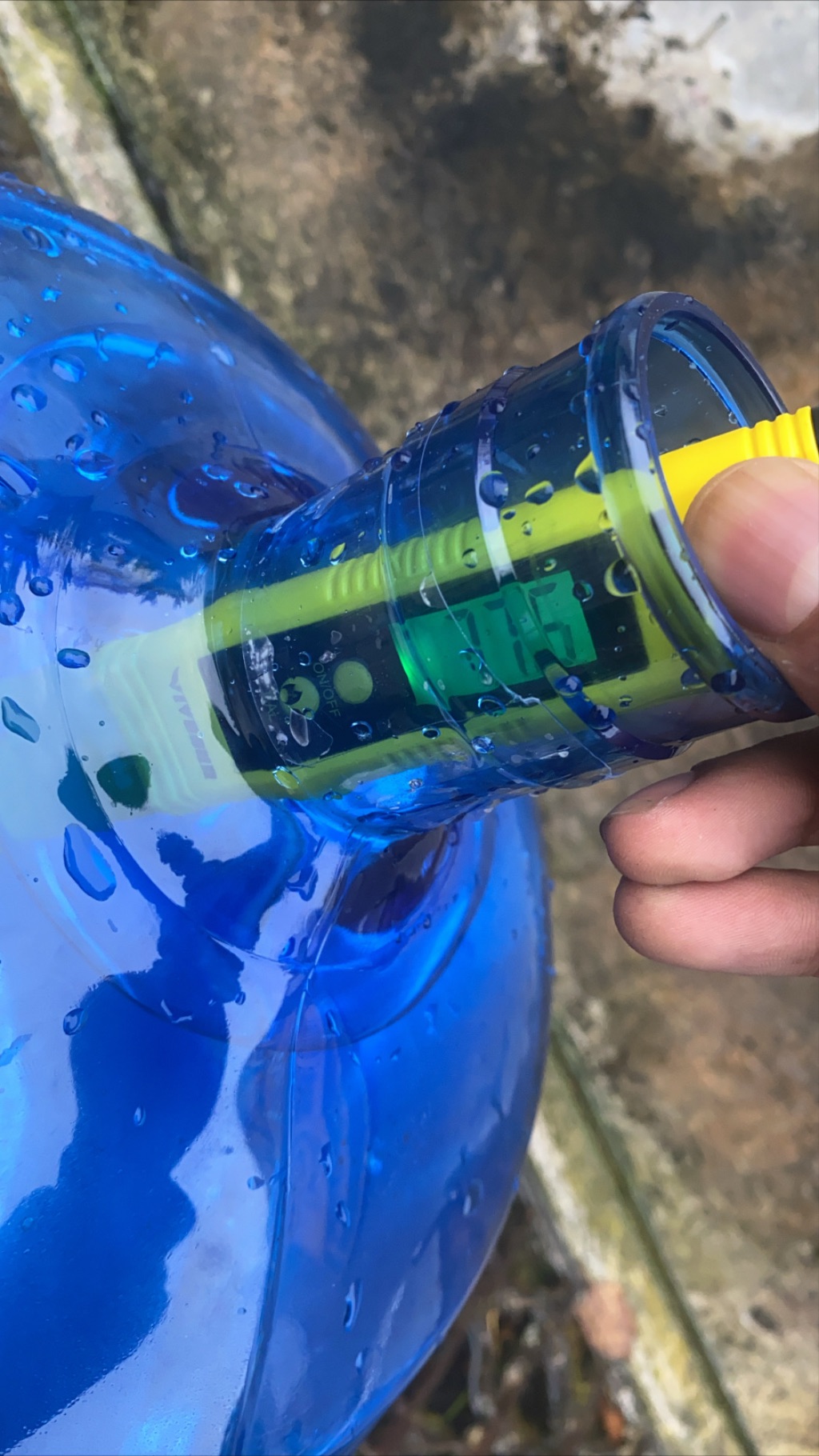
pH 7.8
TDS 205 mg/l (ppm)
Water had a slight odor when we first collected it but it didn’t linger. It is clear and great tasing.
I would be willing to do a complete testing of this water. I’m curious as to what sorts of metals/pollutants would be present, if any. Testing is very expensive though ($200-$400 for a comprehensive test done by a private lab). If anyone would be willing to chip in with the cost, I will e-mail you the results once I get them. Please e-mail chalklakespring@gmail.com and let me know if you’d like to contribute. Thanks!
And to think my father use to take us to Chalk Lake to go swimming in the late 50’s early 60’s. I saw someone drown in that lake. Why is it called Chalk Lake, because of its colour?
If I call the town of Uxbridge, don’t you think they would give us the result of their regular testing? We just want to know if this spring water is good for drinking.
This water is SAFE to drink! The white is calcium build up from it being Hard water. This water is also tested weekly as I talk to many while I am getting my own water and one works for the city water services and she told me they bring in samples weekly for testing.
I have read mixed reviews about this water. I tried it the other day and I agree, it tastes great. My concern is though is it safe? What is the latest developments with the contamination reports from a few years back. It’s super important to solidify this info.
I really appreciate you testing the spring water. Would you mind sharing the results with me? We are new to this and are very excited to start using the spring.
We have been drinking this water for several years now and it is the best tasting water I have had
We drive from Aurora and fill about 120 litres each trip
I have tested the ph and its alkaline at about 8
I also noticed white residue left behind in my water cooler. It also leaves behind jelly like white residue. Not sure what it is. Anyone know? Thanks 🙂
I noticed a lot more white residue and floating stuff which I believe is lime or calcium scale. Which I think is fine to ingest. Still it would be great if the township would test it for metals etc., and take the sign away that says not for human consumption…. The ElmvaleOntario spring doesn’t have such a sign.
I believe that white residue is mineral salts that settle on inside of water bottles after it’s empty. I always rinse out my bottles at site before filling up.
From the name of the lake it flows into , chalk lake . Been drinking this water for over 30 years and used to send in a sample once in a while but always comes back pure . NO chlorine just minerals and some chalk . NOT from treated municipal water often from lake Ontario through pipes of questionable age , material or cleaning .
Drinking pure spring water is one of the most important things we can do for our health. Our bodies are over 99% water at the molecular level, so water affects every aspect of our biology. Yet, not all water is created equal. Almost all the bottled spring water available is pasteurized for shelf stability, which neutralizes many of the powerful health benefits such as increased hydrogen, healthy probiotics, and crystalline structure. For more about why unprocessed spring water is the best water to drink, read this.
The best way to guarantee you are getting real unprocessed spring water is to collect it yourself. This is a short and simple guide filled with information about how to gather spring water. We will cover how to find a spring, how to collect the water, how to honor the spring, how to store the water properly and other tips.
FindASpring.org is the best resource for locating a spring near you. However, not all springs are on the map. First, check the map to see if there is a spring in your local area. If there is, look at the reviews and comments. Has anyone shared helpful information about flow rate or posted a water test result? Is the spring in a pristine area? Do a bit of research and make sure the spring is safe to drink from. If you have any doubt about the purity, don’t risk it and get a water test, HERE. If you don’t see a spring on the map in your area, there still might be some that aren’t listed yet. First, ask the older generation who have lived in your area a long time if they know. You can also ask people in your community who might already get spring water such as people at a health food store or at a farmers market. Another great option is to view A US forest service map, where many springs have been marked. You can view these maps through the Gaia GPS or All Trails hiking apps on your phone. The map overlay you want is USGS Topo. Not all are easily accessible or ideal for drinking, but some are and it can be a fun adventure to find them. We have found over half a dozen great springs this way.
Once you’ve found your spring, figure out how you are going to gather the water. Is it right on the side of the road and easy to access or do you have to hike to it? We recommend storing spring water in glass instead of plastic to preserve the purity of the water. It is better for the environment, your body, and the water. Even BPA free plastic has toxic chemicals that can leach into water and cause health issues. If you do want to use plastic for safety reasons when filling at the spring, we recommend transferring the water to glass as soon as possible. FindASpring is sponsored by Alive Waters, which offers beautiful reusable glass. They have a 2.5 gallon option, which is a convenient size for carrying that isn’t too heavy. They also sell handles that you can use to transport the jugs even more easily. If you have to hike to access the spring, we recommend putting the water jugs into an extra large backpack to hike the water out with ease. We use Osprey packs that hold 2 jugs each. You can also use a wheelbarrow or even a stroller depending on how easy a walk it is.
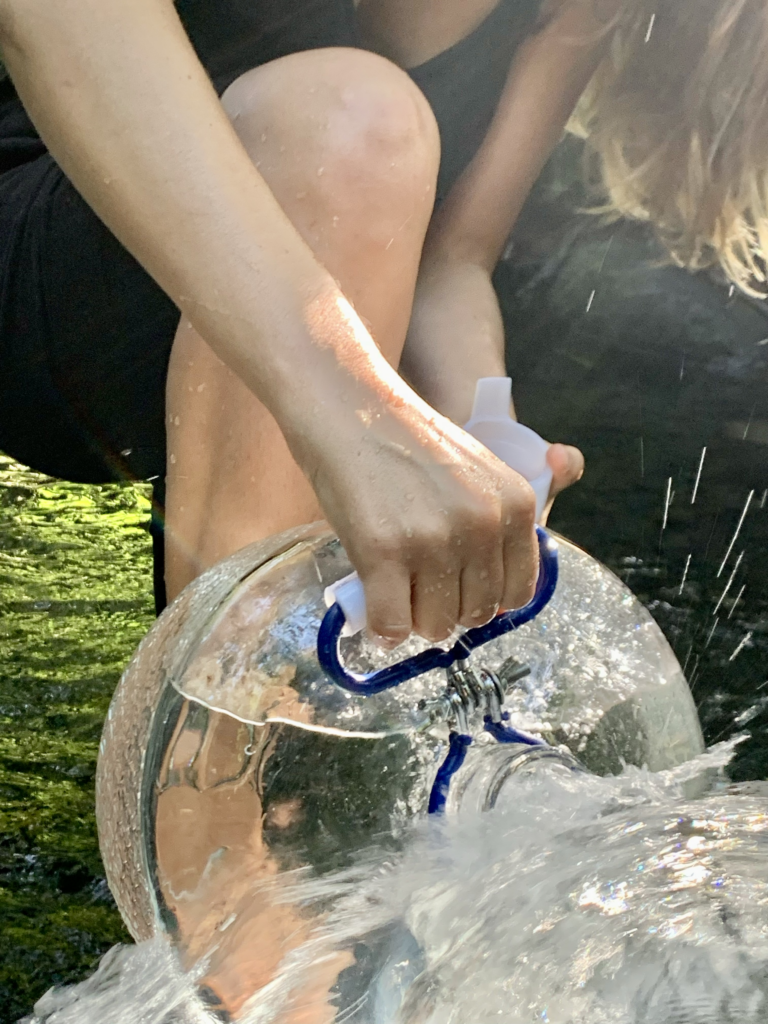
Filling 2.5 Gallon Alive Waters Jug
When you get to the spring, remember to first give back before you take. Springs are considered sacred in indigenous cultures around the world for their life giving water and also as a connection to the inner earth. A powerful and simple way to give back is to clean up. Is there any trash that needs to be collected? Could you move any dead leaves or sticks to improve the flow rate? Show up in service. Some other wonderful ways to give is with a moment of expressing verbal gratitude, singing songs to the water, offering the water an ethically sourced crystal, a feather, or some other physical gift. Flowers are a popular and beautiful thing to offer, but please be careful to source organic ones as most flowers from the store are sprayed with pesticides and can be toxic to put near a spring. Also, flowers can attract bugs as they decay, so it can be best to offer them to the flowing water directly or a little downstream from the spring head.
When gathering the water, fill the jug as close to the spring head as possible, never gather downstream. Be very careful as wet glass is extremely slippery. Make sure the lid is securely fastened. When transporting the spring water home, the jugs can sometimes slide around the car. Secure them in place or wrap them with towels or something so they don’t crash into each other.
How you store your spring water is essential. It is not pasteurized like spring water from the store, so it will start growing algae if left in direct sunlight. This is good because it means it’s alive! If the water you drink can’t even support the most basic life forms, how do you think it will support your body? Store your water in a cool, dark place such as a dark corner, pantry or closet. The fridge is ideal if you have room. Some people prefer to filter their water through a Berkey filter before drinking, but if the spring is pure, it’s not necessary. We drink our spring water completely unfiltered.
How long the water stays good for depends on how cold a temperature it’s stored at. Spring water is best fresh. We personally do not prefer to drink spring water past 2 weeks old. However, we know other people that will drink it at a month old. It’s great to get in a rhythm where you know how long the water lasts you and put your collection day on the calendar in advance.
I believe that water is calling us to reconnect with her in the deepest way, to gather our own water. Just like our ancestors did. Our ancestors didn’t have fancy water machines. They also didn’t create villages or settle where there was no water. Water was revered as the center of the community and the nodal point around which life could spiral out and take root.
Here’s to restoring the sacred connection with the waters of life.
Written by Dakota Chanel. Water Priestess and Ceremonialist. DakotaChanel.com
Do you have info you'd like to add to the main spring description or perhaps a more accurate gps coordinate?
Please start by making a comment on this spring's page with any additional info, or something that you feel should be changed to reflect more accurate data. After your comment is liked by enough community members, this will validate the improved information.
Please notify us if an update with enough likes hasn't been updated in the description yet.
Please note:
This action will also remove this member from your connections and send a report to the site admin.
Please allow a few minutes for this process to complete.

 James
James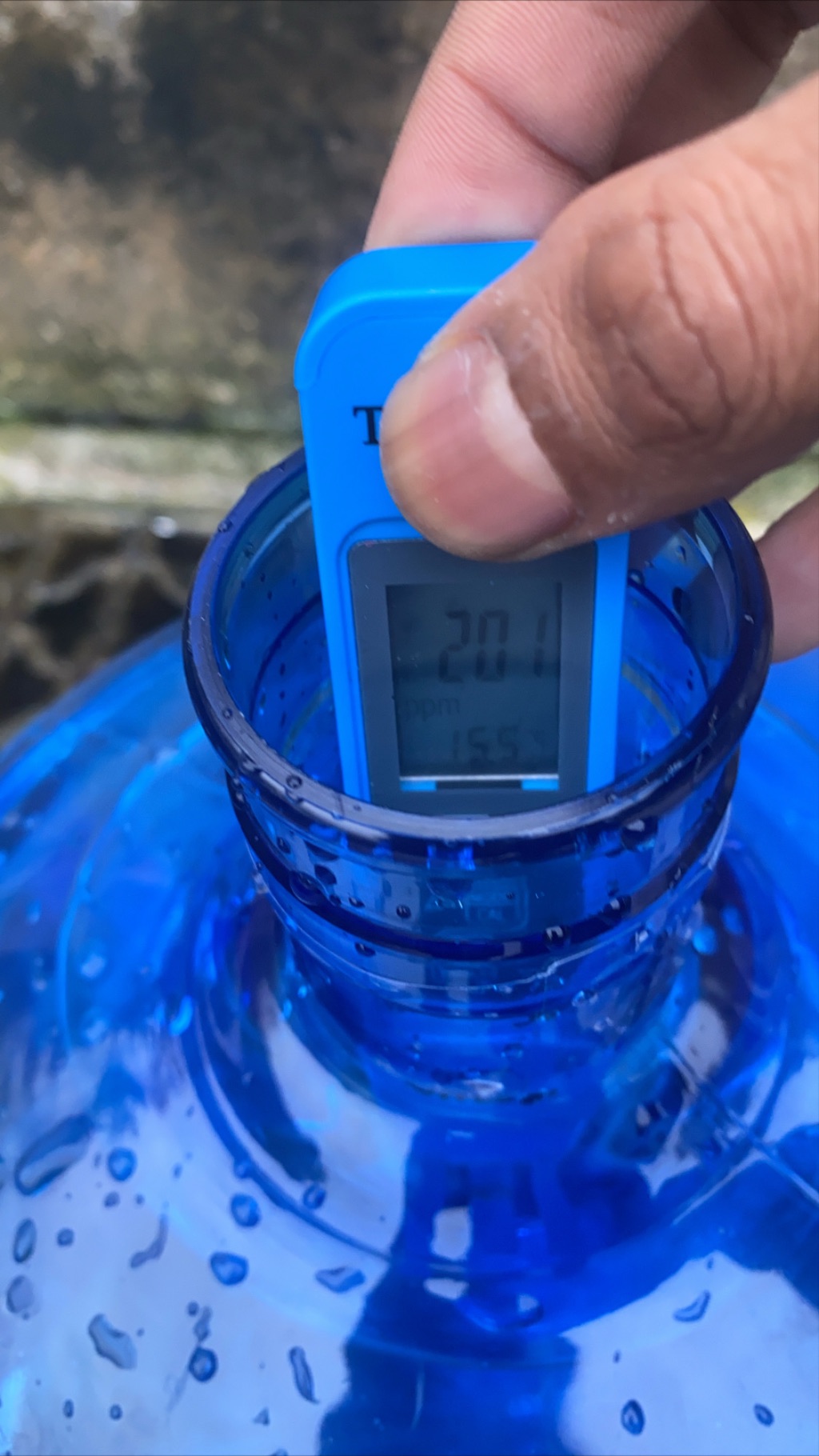

it simply implies that- “not intended” Local de-facto government is just covering their ass should some un-expected situation come about that someone gets sick. Too bad that life, we don’t need a nanny state government.
This water Tastes Much less acidic than the city of Oshawa water. Oshawa water has added chlorine and and fluoride and who knows what else ?
Our family has been drinking from this spring for almost 10 years. Best spring in Ontario. Since moving to Peterborough I make the trip when visiting clients at least once a month. it’s worth the drive!
I used to get water years ago when this spring was on the other side of Lakeridge Rd. I met a Ministry worker there one day when he was testing the water, He Years ago when this spring was on the other side of Lakeridge Rd I met a Ministry worker testing the water. He asked me if I ever got water in the spring to which I answered no, only in the summer and fall. He said in the spring, runoff from the snow as well as particles in the air could contaminate the water
Looking for a ride to share from Toronto! I sold my vehicle and can no longer travel to the spring. Please reach out 647-616-8465
Cheers
Again regarding the test results taken earlier in 2018, take this with a grain of salt. They are strictly a snapshot of the results. Only a regular monitoring and sampling program can determine if any ground water contamination has taken place from the documented and undocumented landfill sites that are in proximity of the spring in the moraine. As a safeguard, filter the water with a conventional activated charcoal filter system (heavy metals, chlorinated products etc. will be removed, but most of the mineral content will still be in the filtered water). I do water sampling and analysis as part of my job and I’m speaking from experience.
This spring has magical, wild water and the most handsome long haired man that comes here.
Hi all! I would like to perform a lab test on the water and I was wondering if anyone would be interested in chipping in to get results. If you are interested please email me at chalklake2024@gmail.com
I have been to the spring as recently as 2 days ago and I noticed new signs saying the water is not fit for human consumption. Does
anyone have any info on this ? Nov 23,2021. Anyone know the stratus of this spring?
I would caution on depending on the recent lab testing done in April 2018 for definitive results. The April testing covered only a small snapshot in terms of time and only a small list of parameters from the Ontario Water Drinking Objectives Regulation 169/03.
To quality the water as drinkable, regular testing is needed against the parameters in Regulation 169/03. The testing would be expensive which is why Durham Region doesn’t test and posted a sign warning of the risks.
Given the known landfills which have contaminated fill further up the Moraine and the unknown areas where contaminated fill could have been dump, I’d put the water through a filter (at least a decent activated charcoal filter if not a multi-stage filter), to lower the risks.
Hi there 🙂 would somebody please send me a copy of the most recent water report, thank you kindly.
Spofakhri@gmail.com
One thing I notice is how many of you are concerned about the water being frequently tested yet u all go back for more without the test results… Water makes up 99% of who we are and we need it to survive. And people are collecting it from an iron pipe in a concrete block and thinking it’s the best water around? I understand that it’s probably better in some ways then tap water or even most bottled water considering the restrictions for our drinking water are so weak I can run toilet water through a Brita and bottle it and sell it having people think it’s natural filtered water and legally get away with it. Quit being cheap and find a corner store with an reverse osmosis system to fill your 5 gallon jugs. The happy market here where I live even has one.so u gotta pay a couple bucks big whoop. Saves u the gas money and puts it toward properly filtered drinking water. Safe drinking water should have a tds value of under 10ppm. And a ph of 7. No higher and no lower especially by drastic amounts. All that excess shit in the water that makes up a high tds value has to be now filtered through your kidney and liver. (Instead of an reverse osmosis machine) your body trys to filter it so you have pure water to hydrate with… Water filters have tonne changed over time. Why arnt u caring about your own internal organs that filter the water. Think those are more robust then the water filters u can buy in stores? Doubt it. All that shit doesn’t come out in your pee i can guarantee that… especially hard metals and byproducts in the water. Alot of that goes straight to ur brain. Main cause of ALOT of disorders and diseases that affect you in a long term way and shows up when you are old. People shouldn’t be dieing in their 70s or losing their minds and forgetting their families at that age… maybe all the bullshit gunked up over years of unhealthy water and food and air is the cause… well we know it’s the cause for the most part… start educating urself on what u need to survive as a human being. Then educate urself on the quality of that of which you’re intaking
We had the water tested and as per the results we got, it is all clear!
Hardness 12 gpg
Iron 0.53 mg/l (ppm)
Manganese 0.1 mg/l (ppm)
pH 7.8
TDS 205 mg/l (ppm)
Water had a slight odor when we first collected it but it didn’t linger. It is clear and great tasing.
I would be willing to do a complete testing of this water. I’m curious as to what sorts of metals/pollutants would be present, if any. Testing is very expensive though ($200-$400 for a comprehensive test done by a private lab). If anyone would be willing to chip in with the cost, I will e-mail you the results once I get them. Please e-mail chalklakespring@gmail.com and let me know if you’d like to contribute. Thanks!
Has anyone gotten back to you yet? I’d love to know as well!
And to think my father use to take us to Chalk Lake to go swimming in the late 50’s early 60’s. I saw someone drown in that lake. Why is it called Chalk Lake, because of its colour?
It’s spring water moron!
TEST RESULTS ARE IN. Tested April, 2018.
Hi. Emailed you regarding obtaining test results. 🙂
Hi Lisa. Would you tell us the test results? Thanks.
Hi! Was going to try this water for some fermenting workshops I’m doing. Can you share the test results? Thanks!
Where can I read about the test results?
I was thinking of using the water, I just moved into the area of Uxbridge and I drive by there every couple of weeks. Is it polluted?
I would love to know the test results. Please post them here!
Is this water safe to drink? I am a cancer survivor looking for a clean, contaminated source of water.
hi Lisa just wanted to know if the water is healthy to drink? thanks so much 🙂
Hi
Is the data available? I have not had a response.
May I ask what the test results were?
Thank you
Hi Lisa,
What are the results from the testing?
Thanks
If I call the town of Uxbridge, don’t you think they would give us the result of their regular testing? We just want to know if this spring water is good for drinking.
Interested in test results.
This water is SAFE to drink! The white is calcium build up from it being Hard water. This water is also tested weekly as I talk to many while I am getting my own water and one works for the city water services and she told me they bring in samples weekly for testing.
Hi friends,
I have read mixed reviews about this water. I tried it the other day and I agree, it tastes great. My concern is though is it safe? What is the latest developments with the contamination reports from a few years back. It’s super important to solidify this info.
Any new updates on this spring? I have never done a test. I drink a lot of this water though!
Hello,
I did a water test kit in the spring water today and all results came back safe. Alkaline was high but within safe range. ????
Sulpher spring in Ancaster is tested every 6 months. It’s a quite a drive from Ajax for me, but for safety sake I switched to spring now.
Hi Lauren:
I am testing this water this month. Please e-mail me for details. Thanks!
chalklakespring@gmail.com
Hi Lisa!
I really appreciate you testing the spring water. Would you mind sharing the results with me? We are new to this and are very excited to start using the spring.
Thank you!
Good evening, what were the test results for the spring in uxbridge? Thank you
Is this water good and good tasting?
We have been drinking this water for several years now and it is the best tasting water I have had
We drive from Aurora and fill about 120 litres each trip
I have tested the ph and its alkaline at about 8
Through your testing, do you feel this water is beneficial to drink?
Hi Mark,
If you’re still curious, e-mail chalklakespring@gmail.com for water test results.
A little research online has made me hesitate to use this spring. read:
https://canadians.org/fr/node/6900
I also noticed white residue left behind in my water cooler. It also leaves behind jelly like white residue. Not sure what it is. Anyone know? Thanks 🙂
I noticed a lot more white residue and floating stuff which I believe is lime or calcium scale. Which I think is fine to ingest. Still it would be great if the township would test it for metals etc., and take the sign away that says not for human consumption…. The ElmvaleOntario spring doesn’t have such a sign.
I believe that white residue is mineral salts that settle on inside of water bottles after it’s empty. I always rinse out my bottles at site before filling up.
e-mail chalklakespring@gmail.com for detailed test results.
Would you be kind to share your results from your testing of the water at Chalk lake spring. I just started using this water.
Thank you
From the name of the lake it flows into , chalk lake . Been drinking this water for over 30 years and used to send in a sample once in a while but always comes back pure . NO chlorine just minerals and some chalk . NOT from treated municipal water often from lake Ontario through pipes of questionable age , material or cleaning .