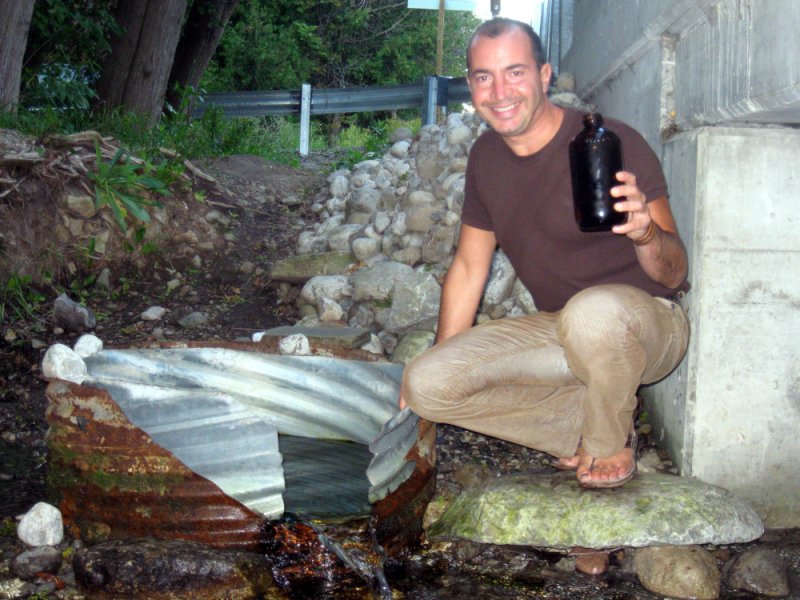
“The Pulsinch Natural Spring is re-born & ready for drinking! This spring is now flowing again after several winters of being dormant from the bridge construction. This is the only non-alkaline water source in the Hamilton area, incredible! Living hydrogen directly from the Earth. The water sample I took shows ZERO on both Total Coliform & E.Coli, more info: https://bit.ly/Es26R” – Mo Rosati
Nearest Address
Intersection of Maddaugh Rd and Macpherson’s Lane.
Directions from Nearest Address
From the above intersection walk down Puslinch Townline about 100 feet & you’ll see the spring under the side of the bridge. See video for details.
Went to the spring today (Dec 3) and got some water. There was a sign saying the water has not been tested but without further information. Should we always boil before drinking? Does that not change the value of it? Is this water contaminated? How do we test it?
You can still drink it.
If you want to kill the bacteria just boil the water before drinking.
Often people still drink contaminated water without boiling (like others posting here) and have no adverse effects, it just means there is the possibility of adverse effects (young and old are at the biggest risk). Bacteria is an indicator of contamination, not a guarantee of having an effect on you.
Do your own research people.
It’s your health.
Don’t just go on word of mouth or forum posts….(I do still feel that spring water is the healthiest option for me but) There are risks in drinking from a source like this. KNOW the risks.
The testing results are posted below. (Reading previous posts is useful.
It was printed out two weeks before the above post, not “just” printed)
I’d appreciate if others taking tests would post the results here so others can be informed as well and make an informed decision on the drinking from this source.
Thanks so much for all your hard work in the testing of this spring Kaylee! With these new results of zero bacterial contamination I think I’ll be checking out this spring very soon 🙂
I was just there today and saw the sign, it said the water was tested on sept 20. On sept 17 I collected 10 gallons and drank it all with no adverse effects. I collected some any ways, I might send a sample to a lab. So far so good though.
I took another water sample on September 20th 2011 and the results are shocking: It came back as having 15 Coliform and 13 E. coli! This is considered unsafe for drinking. (even though I have been drinking it…)
I took another water sample on Aug 23, 2011 and had some disappointing results: 1 E. coli and 1 Coliform. The E. coli shows that there is some sewage contamination. Any E. coli and the ministry deems the water unsafe for drinking.
I just collected some bottles today and had a drink while I was there. This worries me a little… Where so you go to have the water tested? I’m in GUelph, I have more bottles of the water I drank. Would appreciate your thoughts.
I also drank some while I was there taking the sample. I again disclaim I am not an expert (just wielding the sample bottle and my own opinion). It was a week ago so it may be flushed out and clean again by now just watch how you feel and consult a doctor if you get diarrhea (especially bloody they say, with E. coli involved) I did a bit of a internet search after the results came back and found: The E. coli is just an indicator, it doesn’t mean there is something there that will cause problems but the possibility is there. E. coli is an indicator that fecal waste has contaminated the water (could be animal or human no way to tell) and that could lead to disease transfer. May be TMI but I did have a bit of diarrhea 5 days after picking up the last batch but I chalked it up to something I ate as I feel much much better on the spring water (even with a little bacteria) than I do on the RO water I was drinking before, where I had severe issues every single day (and yes, the water was the only thing I changed). I don’t mind drinking it with a little bit of coliform but the e.coli not so much. Sycologicaly I just can’t stand drinking what is contaminated with fecal waste…
I’ll be back later this week for another sample.
I get it tested through the Ministry of Health (those single household use bottles you can pick up, as it is my primary source of water, I just am also sharing the information). I am a bit worried if I take to many samples that come back like this one did that they will shut it down and make it unable to be collected from. (The form requires the location of the sample to be stated and I don’t fib that, not sure they pay attention to it or not)
Hi Brenda, thanks again for taking the time to test the water for us. I’ve had an uncomfortable feeling about it before you told me the results and I’ve already been on the look out for a new source. We’re probably going to stick to the ancaster water for now just to be safe. Although, it is highly unlikely anything would happen to you if you continued to drink from this source. Not sure what’s contaminating it but I think now a spout or lid are probably the best options if anyone wants any help e-mail me at mlbtopshotta@hotmail.com
FOR ANYONE WHO IS STILL DRINKING FROM THIS SOURCE, before collecting your water use your hand to sweep all floating debris from the back area out of the spout. Try to get as much of the non-moving back water out as possible. Once it looks clean let it flow for 5 or 10 minutes and wash itself out. When you collect try to always point your container into the flow. Try not to collect water from the back area.I will post a note at the spring so anyone who doesn’t use this site will know this information as well.
I took a sample on August 3, 2011 (conferred with Mark so we were not duplicating effort. And I was delayed a bit because I did not fully fill out the paperwork when submitted and they do not test then.) and the results have come back showing “Significant Bacteria” results with 8 total coliform and 0 E. coli. (I’ve been drinking the water since though). It did rain the night before I took the sample so wonder if maybe that washed some contamination in? I will take another sample later this week or early next week (whenever the current rain goes away for a bit) to see if anything changes. I am very disappointed that some people have seemed to start using the pull off as an area to dump and wonder if a sign should be put up. Would the dumping have any effect on the spring? Or maybe the bacteria is a result of the drought somehow? Or the rain that happened the day before the sample?
So Aug 3, 2011 results : 8 Total Coliform and 0 E. coli
Hey Kaylee,
Good feedback, if a little disapointing. I realise not all bacteria have to be bad, but I guess you never know. Be interesting to know whether the the hot weather, the rain fall or the dumping is causing this. I need to get involved in the sampling with the rest of you guys I guess. I’m taking a rest from the spring for a bit, though it’s never effected me in a bad way. Will get back involved in a month or two.
Cheers,
Clive
I have been drinking this water since early this year and like others I’ve noticed debris floating in there from time to time. I’ve never been too concerned about it, and I usually just sweep it towards the spout because it can get trapped outside the normal flow. In the last month or 2 I have noticed a lot more tree/road debris in there so I made a large cover for the top. It is fairly light but I tried to make it heavy enough that the wind wouldn’t blow it away in a storm. I’m not much of a handyman so I’m open to suggestions on improving it. Also, if anybody has a reason why it shouldn’t be covered please let me know as well.
Also, like someone else mentioned I would be interested in possibly converting the pipe to a spout in the future. If anyone has more info please contact me about that as well as I would be willing to help as much as I can to maintain this fresh natural drinking source.You can contact me at mlbtopshotta@hotmail.com
I’m in the process of testing the water so I will post the results once I get them.
I am actually heading there today and just came on here to see if anyone had tested the water recently. I will have a look at your contraption and see if I have any suggestions on how to improve. Thanks for taking the time to imrpove this amazing resource.
Hey all… I was thinking about some of the comments by people who were interested in creating a shelter and spout for this spring. I went there for the first time a few weeks ago and am loving the water and think it would be a great idea to tend to it in this way. Is anyone out there still interested in that? Now that the weather is turning it’s the perfect time to rally together with skills and supplies to do it. I’m about as handy as building ikea furniture, but would be willing to put in a bit for supplies (if other people are too). If you’re thinking you want to participate send a comment here so we can get organized. Let’s keep this source clean and flowing!
I’ve started visiting this spring and have been loving the water. I took a sample for bacterial testing on April 10, 2011 and the results came back zero on both Total Coliform & E.Coli. There does seem to be high mineral content as I do get lots of deposits when boiling for tea but the water does not have any visible suspended bits (as some of the visitors below have described, maybe it just need a while to flush out from the construction).
is the water from this spring constantly flowing clean? Because where its coming out of looks rusty and the water filled in there looks unclean. Is it safe to drink?
Visited the spring today and collected three bottles of water. Was wondering if you have done any new tests on the spring. Will probably end up taking samples to the lab to have them analyzed as well for bacterial contamination. Was just wondering if any new tests had revealed any new info on this spring.
Hi Rachael,
I was wondering if you’d had your samples analyzed?
I recently got some glass car boys and will be collecting from Puslinch spring pretty soon. I was also wondering what the best way to clean/sterilize the glass vessel prior to collecting more spring water? Any tips from others?
Thanks,
Clive
Hi Clive.. not sure if you got your answer yet but I do a mix of hot soapy water (to remove any surface stuff that’s accumulated), swirl and shake it around, drain and rinse this and then soak with food grade hydrogen peroxide.
Kerry
Thanks for your reply Kerry. Believe it or not I have some food grade HP in the freezer and so will use it next time for cleaning. I guess you rinse that out afterwards also.
Question for the group: Has anyone used the Adya Clarity product? I bought some and use it with this water. It certainly drops out a bunch of disolved residues/solids if left to sit for 24 hours. Another question: I probably drink 1 1/2 – 2 liters of this water a day and this is the only water I consume. Do you think this is ok? Should I maybe vary the sources of water I’m drinking, a bit like a varied exercise routine? Thanks all!
I also use it as my main water source. I am by NO means an expert but think it should be fine as the only water you consume. If you are concerned about other contaminants and such you can take samples for other parameters (but they would cost you to test. The bacteria sampling is free but that is ONLY the two bacteria contaminations. My co-worker, whos a water guy, says the basic ones for drinking water run around 150$ but testing for very specific things, like pesticide residues, would run you up to 800$). The only thing you may want to consider is the hardness or TDS. I’m not an expert but don’t think you would want those much higher than this spring is…that being said I grew up on well water that was VERY hard and I seem to have turned out fine. 😛 (probably as high or higher than the hardness of this water) I actually feel better when I have some nice hard water (as opposed to RO water or even the nasty tasting softened water).
But you may want to wait for someone who actually knows what they are talking about. 😛
Hi, I was there just yesterday and filled up a glass bottle. When l got home I poured some into a glass and looked at it through a bright light. I noticed some fine thin particles floating around. Probably the same thing that Deb noticed. I drank the water anyway and it tasted great. Does anyone know what these particles are? Should I be worried about them? Should I filter them out?
Thanks,
Chris.
I was there collecting water yesterday and did not see any particles floating around in our carboys except for some algae.
The concern wouldn’t be with large particles as they are probably macromolecules of minerals. The concern really lies in bacterial contamination, if above a certain amount. Unfortunately, you cannot see bacteria floating around.
I wouldn’t be too concerned with the particles. If it bugs you, I would recommend filtering out those particles with a coffee filter. Then again, you are drinking live water, meaning that there are important species in that water that can significantly contribute to your overall health and well being. This would include diatoms, wonderful little phytoplankton from the aglae family. They are wonderful for mecainically killing parasites. Algae is another example and an excellent source of vitamins. It is now being cultivated as a health supplement. Many asian countries have been eating it for thousands of years. If you have eaten seaweed, you have eaten a form of algae.
Anyways, the point being, a coffee filter may remove those important nutrients from the water you are drinking. So keep that in mind when filtering.
Algae is excellent for keeping water clean of chemicals and fertilizer run off from nearby farms. I saw a bit of algae along the galvanized culvert, but I would not deem that as a bad thing. It would serve a great purpose in keeping that water clean and the layer was not very thick.
However, too much algae can indicate that there is a significant amount of nutritional waste in the water. This does not have to mean human waste, it could simply be decayed leaves and grass.
Also, algae are autotrophic organisms (photosynthetic- like plants) that require energy from the sun. If there is too much algae this can indicate that the water is in direct exposure to the sun. This would not be beneficial for those drinking the water as water molecules are broken down by the sun’s energy.
However, my partner and I have been drinking the water and seems to be ok so far in regards to bacterial contamination. I have not received a temperature or any other symptoms indicating infection.
I would not say that there is absolutely ZERO bacteria in this water. However, a manageable amount of bacteria is important in keeping your immune system strong. I believe low levels of bacteria and there other live organisms in this water and extremely beneficial to our health.
Its when bacteria levels are significantly high and the body cannot get rid of the large amount, especially in proliferation, that cause infection. However, the body is designed to eliminiate bacterial infections better than viral infections. As for this moment, I am not overly concerned with drinking this water, especially this time of year as the temperatures are very cold and bacteria need certain temperatures to survive, I would assume that the level of bacterial contamination in this water at this time of year is low.
On Monday, I am sending in a sample to the public health lab here in Hamilton for bacterial analysis.
I will post the results as soon as I get the results back.
Hope this info helps.
I’m in Niagara Falls and was wondering how does one transfer this water home for use. Is large plastic bottles safe….or where would I find a large enough glass jar. Could you contact me by email with an answer. Thank You In Advance. Joe @ joetouch@hotmail.com
From What Mo and Daniel Vitalis say you can use plastic bottles if that’s all you have or go to a wine making store and get some glass carboys (bottles) of all different sizes.
I’ve been told you want to keep the water out of the sun and kept cool, so I wrap the bottles in an old jacket, blanket or sweater etc for transport as well as at home. When home you’ll want to keep them in a cool dark place.
Here’s a video by Mo who did the video about this spring talking about what I’ve just stated. 🙂
Thanks for that Jesse! Some good information there.
I just came accross the websites and it is so wonderful! I knew of one spring in the area(Greensprings, its also an EarthCache) but was unsure if it was drinkable or not. Until last summer I had the most wonderful drinking water at work. We had a spring source that came straight to the ‘office’ building and I loved it and would take it home to drink. Sadly because it is a workplace and the TDS were a bit high they re-vamped the whole system and now we are FORCED to drink overly salted softened water or nutrient defficient and dead tasting RO water. While I am grateful we at least have the RO I was extreemly upset when they did not even give us an option of an un-softened tap. Talk about taking our water rights away… So disappointing…the best water I’ve had in a very very long time and they go and ruin it. My water at (my rented) home is worse, softened to the point I can hardly drink it sometimes…not refreshing in the least! So bad my tea and flavored drinks even taste bad! I finally decided there had to be a site like this to find local spring sources. So grateful to have found it. Will be making a trip to my local springs this week.
Hi…I’m so glad I found this site after watching another video from the Longevity Conference. I’m in Niagara Fallls and wonder; what is best for transporting and saving this water for use.?
Hi Mo,
Thanks for posting the info about this spring. I have collected from this spring for about 7 years. The longest collectors I have met was an elderly couple who have been going there for over 30 years, I have only heard good things about it.
The interruption from the new bridge was a frustration, but have been happy to be able to access it again. I have concerns about it though, and I would appreciate your thoughts. My friend who was visiting me noticed some tiny white floating particles in the water. We went to the source and checked it out with a clear glass and it is definitely coming out that way. I don’t know if this is a new thing from the new set up or was always the case from the previous set up? What do you think it could be? Is it safe? Is it just natural minerals, you said it was low on calcium? Am I so programmed to drink filtered water that I can’t even recognize good water when I see it? It seems safe, and your testing is reassuring, I have poured the water through a natural coffee filter, it took out most of it.
Thank you
Deb
I’m going today for the first time this sounds a little weird, as well as the structure it’s coming from. I would really like to hear what Mo has to say about this as well. 🙂
Haven’t been back on for a while so here is my update. After I filtered the first jug, I decided it was kind of a pain and not necessary, so I didn’t filter the rest of them (3). I didn’t experience any ill effect. I probably go about once/month and I kind of forgot about it since it didn’t seem a problem, so I don’t know when it stopped but they don’t seem to be in the water now. Maybe something to keep an eye on seasonally, ie. see if it happens again 7 months from now.
Anyway, it’s curious, but not a big worry, I think.
Cheers
Deb
This springs great!! just curious if any body else who uses it likes when people throw things in the main watering hole ????? Me i dont want it to be a wishing well full of coins so im wondering if anybody wants to improve it with me and fix it up a bit. some sort of cover or back fill it a bit maybe even a spout? im game for ideas
THanks
jay
Hi Jay,
Yes I don’t like things thrown in, I noticed that too. I have never seen any problems, like this before in all of my time going there. A cover and spout would be great!
Deb
Hey Jay,
Count me in on any fix up we can do here. It really does need some sort of cover, especially to shield from sunlight, as well as keeping out debris. Keep me in the loop!
Mo, is there a concern at all that this spring would be contaminated by road debris, salt etc? Unlike Ancaster this does not flow from a pipe making it more difficult to gather?
Mo, is there a concern at all that this spring would be contaminated by road debris, salt etc? Unlike Ancaster this does not flow from a pipe making it more difficult to gather?
I’m not worried about road debris, if you are then just wait 24 hours after a rain (or snow) fall and the spring should flush itself out with new water and wash any water born debris away. If it was a heavily traveled road or something I would be more concerned, and would wish it had more protection.
It is a bit more difficult to collect as you have to lift the bottles up from so low but its not so much so that it deters people from gathering (it seems very well used), it doesn’t bother me.
I live in the detroit area and just moved back from Germany where I had access to great water from my tap and from local springs. I did not have to educate myself since the information was posted at the spring about the water. I really would like to visit the spring at Pushlich could you offer and tip for our trip there? Are there any group that meet and hike to springs?
Thanks,
Angela
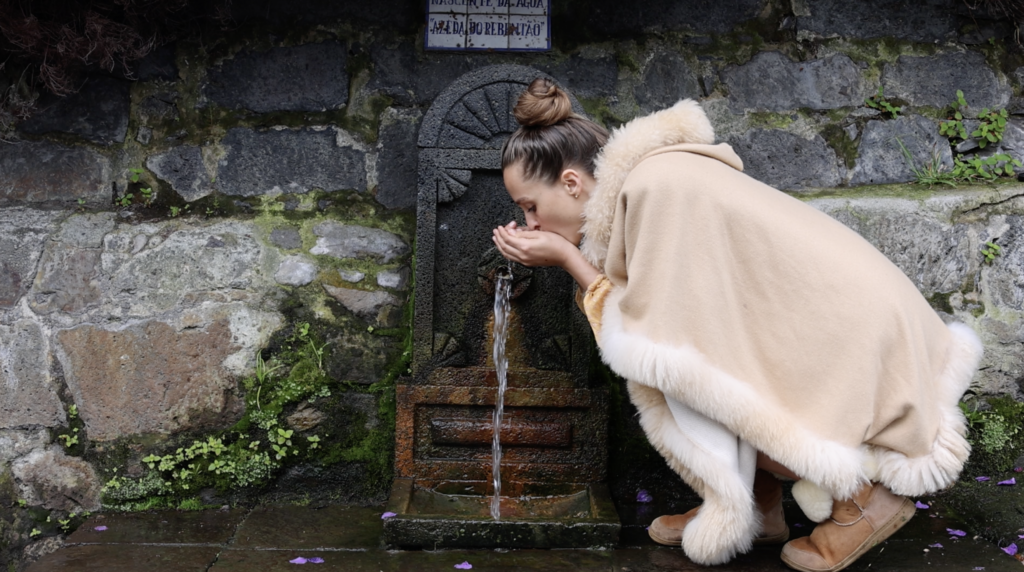
Drinking pure spring water is one of the most important things we can do for our health. Our bodies are over 99% water at the molecular level, so water affects every aspect of our biology. Yet, not all water is created equal. Almost all the bottled spring water available is pasteurized for shelf stability, which neutralizes many of the powerful health benefits such as increased hydrogen, healthy probiotics, and crystalline structure. For more about why unprocessed spring water is the best water to drink, read this.
The best way to guarantee you are getting real unprocessed spring water is to collect it yourself. This is a short and simple guide filled with information about how to gather spring water. We will cover how to find a spring, how to collect the water, how to honor the spring, how to store the water properly and other tips.
FindASpring.org is the best resource for locating a spring near you. However, not all springs are on the map. First, check the map to see if there is a spring in your local area. If there is, look at the reviews and comments. Has anyone shared helpful information about flow rate or posted a water test result? Is the spring in a pristine area? Do a bit of research and make sure the spring is safe to drink from. If you have any doubt about the purity, don’t risk it and get a water test, HERE. If you don’t see a spring on the map in your area, there still might be some that aren’t listed yet. First, ask the older generation who have lived in your area a long time if they know. You can also ask people in your community who might already get spring water such as people at a health food store or at a farmers market. Another great option is to view A US forest service map, where many springs have been marked. You can view these maps through the Gaia GPS or All Trails hiking apps on your phone. The map overlay you want is USGS Topo. Not all are easily accessible or ideal for drinking, but some are and it can be a fun adventure to find them. We have found over half a dozen great springs this way.
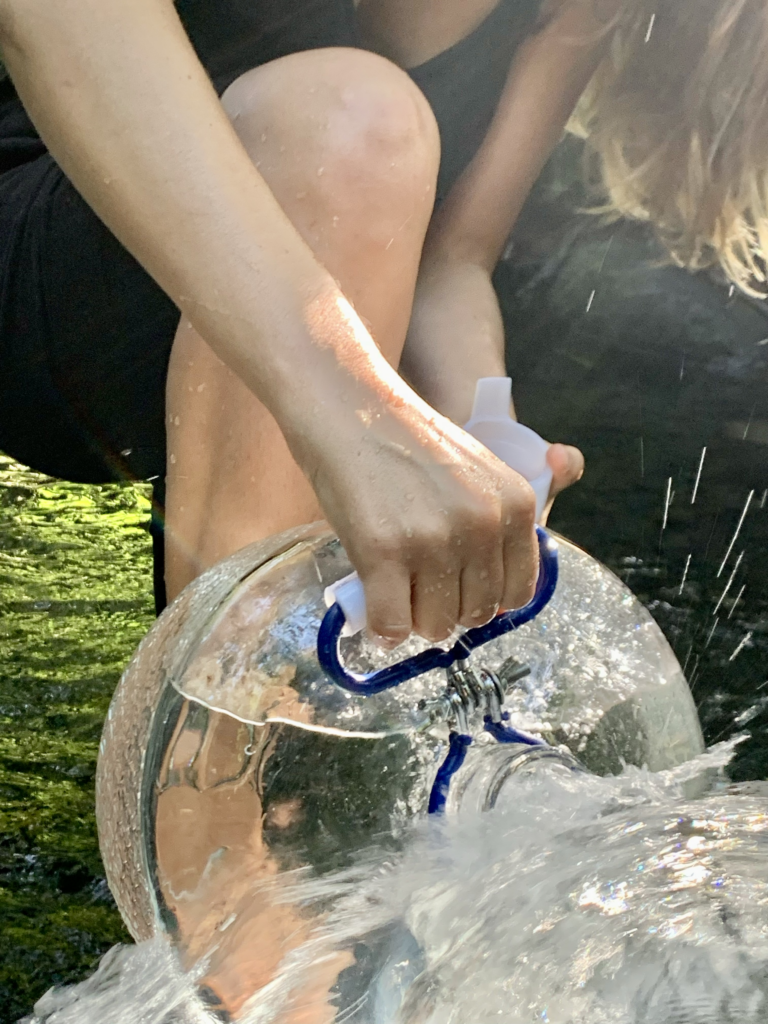
Once you’ve found your spring, figure out how you are going to gather the water. Is it right on the side of the road and easy to access or do you have to hike to it? We recommend storing spring water in glass instead of plastic to preserve the purity of the water. It is better for the environment, your body, and the water. Even BPA free plastic has toxic chemicals that can leach into water and cause health issues. If you do want to use plastic for safety reasons when filling at the spring, we recommend transferring the water to glass as soon as possible. FindASpring is sponsored by Alive Waters, which offers beautiful reusable glass. They have a 2.5 gallon option, which is a convenient size for carrying that isn’t too heavy. They also sell handles that you can use to transport the jugs even more easily. If you have to hike to access the spring, we recommend putting the water jugs into an extra large backpack to hike the water out with ease. We use Osprey packs that hold 2 jugs each. You can also use a wheelbarrow or even a stroller depending on how easy a walk it is.
Filling 2.5 Gallon Alive Waters Jug
When you get to the spring, remember to first give back before you take. Springs are considered sacred in indigenous cultures around the world for their life giving water and also as a connection to the inner earth. A powerful and simple way to give back is to clean up. Is there any trash that needs to be collected? Could you move any dead leaves or sticks to improve the flow rate? Show up in service. Some other wonderful ways to give is with a moment of expressing verbal gratitude, singing songs to the water, offering the water an ethically sourced crystal, a feather, or some other physical gift. Flowers are a popular and beautiful thing to offer, but please be careful to source organic ones as most flowers from the store are sprayed with pesticides and can be toxic to put near a spring. Also, flowers can attract bugs as they decay, so it can be best to offer them to the flowing water directly or a little downstream from the spring head.
When gathering the water, fill the jug as close to the spring head as possible, never gather downstream. Be very careful as wet glass is extremely slippery. Make sure the lid is securely fastened. When transporting the spring water home, the jugs can sometimes slide around the car. Secure them in place or wrap them with towels or something so they don’t crash into each other.
How you store your spring water is essential. It is not pasteurized like spring water from the store, so it will start growing algae if left in direct sunlight. This is good because it means it’s alive! If the water you drink can’t even support the most basic life forms, how do you think it will support your body? Store your water in a cool, dark place such as a dark corner, pantry or closet. The fridge is ideal if you have room. Some people prefer to filter their water through a Berkey filter before drinking, but if the spring is pure, it’s not necessary. We drink our spring water completely unfiltered.
How long the water stays good for depends on how cold a temperature it’s stored at. Spring water is best fresh. We personally do not prefer to drink spring water past 2 weeks old. However, we know other people that will drink it at a month old. It’s great to get in a rhythm where you know how long the water lasts you and put your collection day on the calendar in advance.
I believe that water is calling us to reconnect with her in the deepest way, to gather our own water. Just like our ancestors did. Our ancestors didn’t have fancy water machines. They also didn’t create villages or settle where there was no water. Water was revered as the center of the community and the nodal point around which life could spiral out and take root.
Here’s to restoring the sacred connection with the waters of life.
Written by Dakota Chanel. Water Priestess and Ceremonialist. DakotaChanel.com
Do you have info you'd like to add to the main spring description or perhaps a more accurate gps coordinate?
Please start by making a comment on this spring's page with any additional info, or something that you feel should be changed to reflect more accurate data. After your comment is liked by enough community members, this will validate the improved information.
Please notify us if an update with enough likes hasn't been updated in the description yet.
Please note:
This action will also remove this member from your connections and send a report to the site admin.
Please allow a few minutes for this process to complete.


Sample taken Feb 5, 2012 had results of 0 Coliform and 0 E. coli.
Went to the spring today (Dec 3) and got some water. There was a sign saying the water has not been tested but without further information. Should we always boil before drinking? Does that not change the value of it? Is this water contaminated? How do we test it?
The government has to put that sign up. Kaylee tested the water and as of nov 2 all is good. Boil if you wish.
A sample taken on November 2, 2011 show good results: 1 Coliform and 0 E. coli so the water should be safe to drink without boiling again.
Someone just posted a printed out sheet saying it has been contaminated
with a bunch of e-coli. Better not use it until further testing.
Where else do we go now???
You can still drink it.
If you want to kill the bacteria just boil the water before drinking.
Often people still drink contaminated water without boiling (like others posting here) and have no adverse effects, it just means there is the possibility of adverse effects (young and old are at the biggest risk). Bacteria is an indicator of contamination, not a guarantee of having an effect on you.
Do your own research people.
It’s your health.
Don’t just go on word of mouth or forum posts….(I do still feel that spring water is the healthiest option for me but) There are risks in drinking from a source like this. KNOW the risks.
The testing results are posted below. (Reading previous posts is useful.
It was printed out two weeks before the above post, not “just” printed)
I’d appreciate if others taking tests would post the results here so others can be informed as well and make an informed decision on the drinking from this source.
Good advice Kaylee!! It is important to be informed and understand the risks involved. Still no issues from drinking this water.
In case people don’t read ‘newest post first’ I’ll repeat it here :Sample taken Feb 5, 2012 had results of 0 Coliform and 0 E. coli.
Thanks so much for all your hard work in the testing of this spring Kaylee! With these new results of zero bacterial contamination I think I’ll be checking out this spring very soon 🙂
I was just there today and saw the sign, it said the water was tested on sept 20. On sept 17 I collected 10 gallons and drank it all with no adverse effects. I collected some any ways, I might send a sample to a lab. So far so good though.
I took another water sample on September 20th 2011 and the results are shocking: It came back as having 15 Coliform and 13 E. coli! This is considered unsafe for drinking. (even though I have been drinking it…)
I took another water sample on Aug 23, 2011 and had some disappointing results: 1 E. coli and 1 Coliform. The E. coli shows that there is some sewage contamination. Any E. coli and the ministry deems the water unsafe for drinking.
I just collected some bottles today and had a drink while I was there. This worries me a little… Where so you go to have the water tested? I’m in GUelph, I have more bottles of the water I drank. Would appreciate your thoughts.
I also drank some while I was there taking the sample. I again disclaim I am not an expert (just wielding the sample bottle and my own opinion). It was a week ago so it may be flushed out and clean again by now just watch how you feel and consult a doctor if you get diarrhea (especially bloody they say, with E. coli involved) I did a bit of a internet search after the results came back and found: The E. coli is just an indicator, it doesn’t mean there is something there that will cause problems but the possibility is there. E. coli is an indicator that fecal waste has contaminated the water (could be animal or human no way to tell) and that could lead to disease transfer. May be TMI but I did have a bit of diarrhea 5 days after picking up the last batch but I chalked it up to something I ate as I feel much much better on the spring water (even with a little bacteria) than I do on the RO water I was drinking before, where I had severe issues every single day (and yes, the water was the only thing I changed). I don’t mind drinking it with a little bit of coliform but the e.coli not so much. Sycologicaly I just can’t stand drinking what is contaminated with fecal waste…
I’ll be back later this week for another sample.
I get it tested through the Ministry of Health (those single household use bottles you can pick up, as it is my primary source of water, I just am also sharing the information). I am a bit worried if I take to many samples that come back like this one did that they will shut it down and make it unable to be collected from. (The form requires the location of the sample to be stated and I don’t fib that, not sure they pay attention to it or not)
Hi Brenda, thanks again for taking the time to test the water for us. I’ve had an uncomfortable feeling about it before you told me the results and I’ve already been on the look out for a new source. We’re probably going to stick to the ancaster water for now just to be safe. Although, it is highly unlikely anything would happen to you if you continued to drink from this source. Not sure what’s contaminating it but I think now a spout or lid are probably the best options if anyone wants any help e-mail me at mlbtopshotta@hotmail.com
FOR ANYONE WHO IS STILL DRINKING FROM THIS SOURCE, before collecting your water use your hand to sweep all floating debris from the back area out of the spout. Try to get as much of the non-moving back water out as possible. Once it looks clean let it flow for 5 or 10 minutes and wash itself out. When you collect try to always point your container into the flow. Try not to collect water from the back area.I will post a note at the spring so anyone who doesn’t use this site will know this information as well.
I took a sample on August 3, 2011 (conferred with Mark so we were not duplicating effort. And I was delayed a bit because I did not fully fill out the paperwork when submitted and they do not test then.) and the results have come back showing “Significant Bacteria” results with 8 total coliform and 0 E. coli. (I’ve been drinking the water since though). It did rain the night before I took the sample so wonder if maybe that washed some contamination in? I will take another sample later this week or early next week (whenever the current rain goes away for a bit) to see if anything changes. I am very disappointed that some people have seemed to start using the pull off as an area to dump and wonder if a sign should be put up. Would the dumping have any effect on the spring? Or maybe the bacteria is a result of the drought somehow? Or the rain that happened the day before the sample?
So Aug 3, 2011 results : 8 Total Coliform and 0 E. coli
Hey Kaylee,
Good feedback, if a little disapointing. I realise not all bacteria have to be bad, but I guess you never know. Be interesting to know whether the the hot weather, the rain fall or the dumping is causing this. I need to get involved in the sampling with the rest of you guys I guess. I’m taking a rest from the spring for a bit, though it’s never effected me in a bad way. Will get back involved in a month or two.
Cheers,
Clive
I have been drinking this water since early this year and like others I’ve noticed debris floating in there from time to time. I’ve never been too concerned about it, and I usually just sweep it towards the spout because it can get trapped outside the normal flow. In the last month or 2 I have noticed a lot more tree/road debris in there so I made a large cover for the top. It is fairly light but I tried to make it heavy enough that the wind wouldn’t blow it away in a storm. I’m not much of a handyman so I’m open to suggestions on improving it. Also, if anybody has a reason why it shouldn’t be covered please let me know as well.
Also, like someone else mentioned I would be interested in possibly converting the pipe to a spout in the future. If anyone has more info please contact me about that as well as I would be willing to help as much as I can to maintain this fresh natural drinking source.You can contact me at mlbtopshotta@hotmail.com
I’m in the process of testing the water so I will post the results once I get them.
I am actually heading there today and just came on here to see if anyone had tested the water recently. I will have a look at your contraption and see if I have any suggestions on how to improve. Thanks for taking the time to imrpove this amazing resource.
Hey all… I was thinking about some of the comments by people who were interested in creating a shelter and spout for this spring. I went there for the first time a few weeks ago and am loving the water and think it would be a great idea to tend to it in this way. Is anyone out there still interested in that? Now that the weather is turning it’s the perfect time to rally together with skills and supplies to do it. I’m about as handy as building ikea furniture, but would be willing to put in a bit for supplies (if other people are too). If you’re thinking you want to participate send a comment here so we can get organized. Let’s keep this source clean and flowing!
I’ve started visiting this spring and have been loving the water. I took a sample for bacterial testing on April 10, 2011 and the results came back zero on both Total Coliform & E.Coli. There does seem to be high mineral content as I do get lots of deposits when boiling for tea but the water does not have any visible suspended bits (as some of the visitors below have described, maybe it just need a while to flush out from the construction).
is the water from this spring constantly flowing clean? Because where its coming out of looks rusty and the water filled in there looks unclean. Is it safe to drink?
Hi Mo,
Visited the spring today and collected three bottles of water. Was wondering if you have done any new tests on the spring. Will probably end up taking samples to the lab to have them analyzed as well for bacterial contamination. Was just wondering if any new tests had revealed any new info on this spring.
Thanks,
Rachael
jbakker@uoguelph.ca
Hi Rachael,
I was wondering if you’d had your samples analyzed?
I recently got some glass car boys and will be collecting from Puslinch spring pretty soon. I was also wondering what the best way to clean/sterilize the glass vessel prior to collecting more spring water? Any tips from others?
Thanks,
Clive
Hi Clive.. not sure if you got your answer yet but I do a mix of hot soapy water (to remove any surface stuff that’s accumulated), swirl and shake it around, drain and rinse this and then soak with food grade hydrogen peroxide.
Kerry
Thanks for your reply Kerry. Believe it or not I have some food grade HP in the freezer and so will use it next time for cleaning. I guess you rinse that out afterwards also.
Question for the group: Has anyone used the Adya Clarity product? I bought some and use it with this water. It certainly drops out a bunch of disolved residues/solids if left to sit for 24 hours. Another question: I probably drink 1 1/2 – 2 liters of this water a day and this is the only water I consume. Do you think this is ok? Should I maybe vary the sources of water I’m drinking, a bit like a varied exercise routine? Thanks all!
I also use it as my main water source. I am by NO means an expert but think it should be fine as the only water you consume. If you are concerned about other contaminants and such you can take samples for other parameters (but they would cost you to test. The bacteria sampling is free but that is ONLY the two bacteria contaminations. My co-worker, whos a water guy, says the basic ones for drinking water run around 150$ but testing for very specific things, like pesticide residues, would run you up to 800$). The only thing you may want to consider is the hardness or TDS. I’m not an expert but don’t think you would want those much higher than this spring is…that being said I grew up on well water that was VERY hard and I seem to have turned out fine. 😛 (probably as high or higher than the hardness of this water) I actually feel better when I have some nice hard water (as opposed to RO water or even the nasty tasting softened water).
But you may want to wait for someone who actually knows what they are talking about. 😛
Hi, I was there just yesterday and filled up a glass bottle. When l got home I poured some into a glass and looked at it through a bright light. I noticed some fine thin particles floating around. Probably the same thing that Deb noticed. I drank the water anyway and it tasted great. Does anyone know what these particles are? Should I be worried about them? Should I filter them out?
Thanks,
Chris.
Hi Chris,
I was there collecting water yesterday and did not see any particles floating around in our carboys except for some algae.
The concern wouldn’t be with large particles as they are probably macromolecules of minerals. The concern really lies in bacterial contamination, if above a certain amount. Unfortunately, you cannot see bacteria floating around.
I wouldn’t be too concerned with the particles. If it bugs you, I would recommend filtering out those particles with a coffee filter. Then again, you are drinking live water, meaning that there are important species in that water that can significantly contribute to your overall health and well being. This would include diatoms, wonderful little phytoplankton from the aglae family. They are wonderful for mecainically killing parasites. Algae is another example and an excellent source of vitamins. It is now being cultivated as a health supplement. Many asian countries have been eating it for thousands of years. If you have eaten seaweed, you have eaten a form of algae.
Anyways, the point being, a coffee filter may remove those important nutrients from the water you are drinking. So keep that in mind when filtering.
Algae is excellent for keeping water clean of chemicals and fertilizer run off from nearby farms. I saw a bit of algae along the galvanized culvert, but I would not deem that as a bad thing. It would serve a great purpose in keeping that water clean and the layer was not very thick.
However, too much algae can indicate that there is a significant amount of nutritional waste in the water. This does not have to mean human waste, it could simply be decayed leaves and grass.
Also, algae are autotrophic organisms (photosynthetic- like plants) that require energy from the sun. If there is too much algae this can indicate that the water is in direct exposure to the sun. This would not be beneficial for those drinking the water as water molecules are broken down by the sun’s energy.
However, my partner and I have been drinking the water and seems to be ok so far in regards to bacterial contamination. I have not received a temperature or any other symptoms indicating infection.
I would not say that there is absolutely ZERO bacteria in this water. However, a manageable amount of bacteria is important in keeping your immune system strong. I believe low levels of bacteria and there other live organisms in this water and extremely beneficial to our health.
Its when bacteria levels are significantly high and the body cannot get rid of the large amount, especially in proliferation, that cause infection. However, the body is designed to eliminiate bacterial infections better than viral infections. As for this moment, I am not overly concerned with drinking this water, especially this time of year as the temperatures are very cold and bacteria need certain temperatures to survive, I would assume that the level of bacterial contamination in this water at this time of year is low.
On Monday, I am sending in a sample to the public health lab here in Hamilton for bacterial analysis.
I will post the results as soon as I get the results back.
Hope this info helps.
I’m in Niagara Falls and was wondering how does one transfer this water home for use. Is large plastic bottles safe….or where would I find a large enough glass jar. Could you contact me by email with an answer. Thank You In Advance. Joe @ joetouch@hotmail.com
Hey Joe 🙂
From What Mo and Daniel Vitalis say you can use plastic bottles if that’s all you have or go to a wine making store and get some glass carboys (bottles) of all different sizes.
For how to transport go to about 3:20 on this video (or watch the whole thing:)
https://www.youtube.com/watch?v=Gk44Y982v4M
I’ve been told you want to keep the water out of the sun and kept cool, so I wrap the bottles in an old jacket, blanket or sweater etc for transport as well as at home. When home you’ll want to keep them in a cool dark place.
Here’s a video by Mo who did the video about this spring talking about what I’ve just stated. 🙂
Peace
Jesse
Here’s the Mo video. 🙂 I thought I put it in there but……….here it is, enjoy. 🙂
https://www.youtube.com/watch?v=zIZe0iTJQis
Jesse
Thanks for that Jesse! Some good information there.
I just came accross the websites and it is so wonderful! I knew of one spring in the area(Greensprings, its also an EarthCache) but was unsure if it was drinkable or not. Until last summer I had the most wonderful drinking water at work. We had a spring source that came straight to the ‘office’ building and I loved it and would take it home to drink. Sadly because it is a workplace and the TDS were a bit high they re-vamped the whole system and now we are FORCED to drink overly salted softened water or nutrient defficient and dead tasting RO water. While I am grateful we at least have the RO I was extreemly upset when they did not even give us an option of an un-softened tap. Talk about taking our water rights away… So disappointing…the best water I’ve had in a very very long time and they go and ruin it. My water at (my rented) home is worse, softened to the point I can hardly drink it sometimes…not refreshing in the least! So bad my tea and flavored drinks even taste bad! I finally decided there had to be a site like this to find local spring sources. So grateful to have found it. Will be making a trip to my local springs this week.
Hi…I’m so glad I found this site after watching another video from the Longevity Conference. I’m in Niagara Fallls and wonder; what is best for transporting and saving this water for use.?
Hi Mo,
Thanks for posting the info about this spring. I have collected from this spring for about 7 years. The longest collectors I have met was an elderly couple who have been going there for over 30 years, I have only heard good things about it.
The interruption from the new bridge was a frustration, but have been happy to be able to access it again. I have concerns about it though, and I would appreciate your thoughts. My friend who was visiting me noticed some tiny white floating particles in the water. We went to the source and checked it out with a clear glass and it is definitely coming out that way. I don’t know if this is a new thing from the new set up or was always the case from the previous set up? What do you think it could be? Is it safe? Is it just natural minerals, you said it was low on calcium? Am I so programmed to drink filtered water that I can’t even recognize good water when I see it? It seems safe, and your testing is reassuring, I have poured the water through a natural coffee filter, it took out most of it.
Thank you
Deb
I’m going today for the first time this sounds a little weird, as well as the structure it’s coming from. I would really like to hear what Mo has to say about this as well. 🙂
Haven’t been back on for a while so here is my update. After I filtered the first jug, I decided it was kind of a pain and not necessary, so I didn’t filter the rest of them (3). I didn’t experience any ill effect. I probably go about once/month and I kind of forgot about it since it didn’t seem a problem, so I don’t know when it stopped but they don’t seem to be in the water now. Maybe something to keep an eye on seasonally, ie. see if it happens again 7 months from now.
Anyway, it’s curious, but not a big worry, I think.
Cheers
Deb
This springs great!! just curious if any body else who uses it likes when people throw things in the main watering hole ????? Me i dont want it to be a wishing well full of coins so im wondering if anybody wants to improve it with me and fix it up a bit. some sort of cover or back fill it a bit maybe even a spout? im game for ideas
THanks
jay
Hi Jay,
Yes I don’t like things thrown in, I noticed that too. I have never seen any problems, like this before in all of my time going there. A cover and spout would be great!
Deb
Hey Jay,
Count me in on any fix up we can do here. It really does need some sort of cover, especially to shield from sunlight, as well as keeping out debris. Keep me in the loop!
~ Massimo
mrosati72@gmail.com
Mo, is there a concern at all that this spring would be contaminated by road debris, salt etc? Unlike Ancaster this does not flow from a pipe making it more difficult to gather?
Mo, is there a concern at all that this spring would be contaminated by road debris, salt etc? Unlike Ancaster this does not flow from a pipe making it more difficult to gather?
I’m not worried about road debris, if you are then just wait 24 hours after a rain (or snow) fall and the spring should flush itself out with new water and wash any water born debris away. If it was a heavily traveled road or something I would be more concerned, and would wish it had more protection.
It is a bit more difficult to collect as you have to lift the bottles up from so low but its not so much so that it deters people from gathering (it seems very well used), it doesn’t bother me.
I live in the detroit area and just moved back from Germany where I had access to great water from my tap and from local springs. I did not have to educate myself since the information was posted at the spring about the water. I really would like to visit the spring at Pushlich could you offer and tip for our trip there? Are there any group that meet and hike to springs?
Thanks,
Angela
Awesome, thanks for sharing all the info Mo, I look forward to visiting the spring