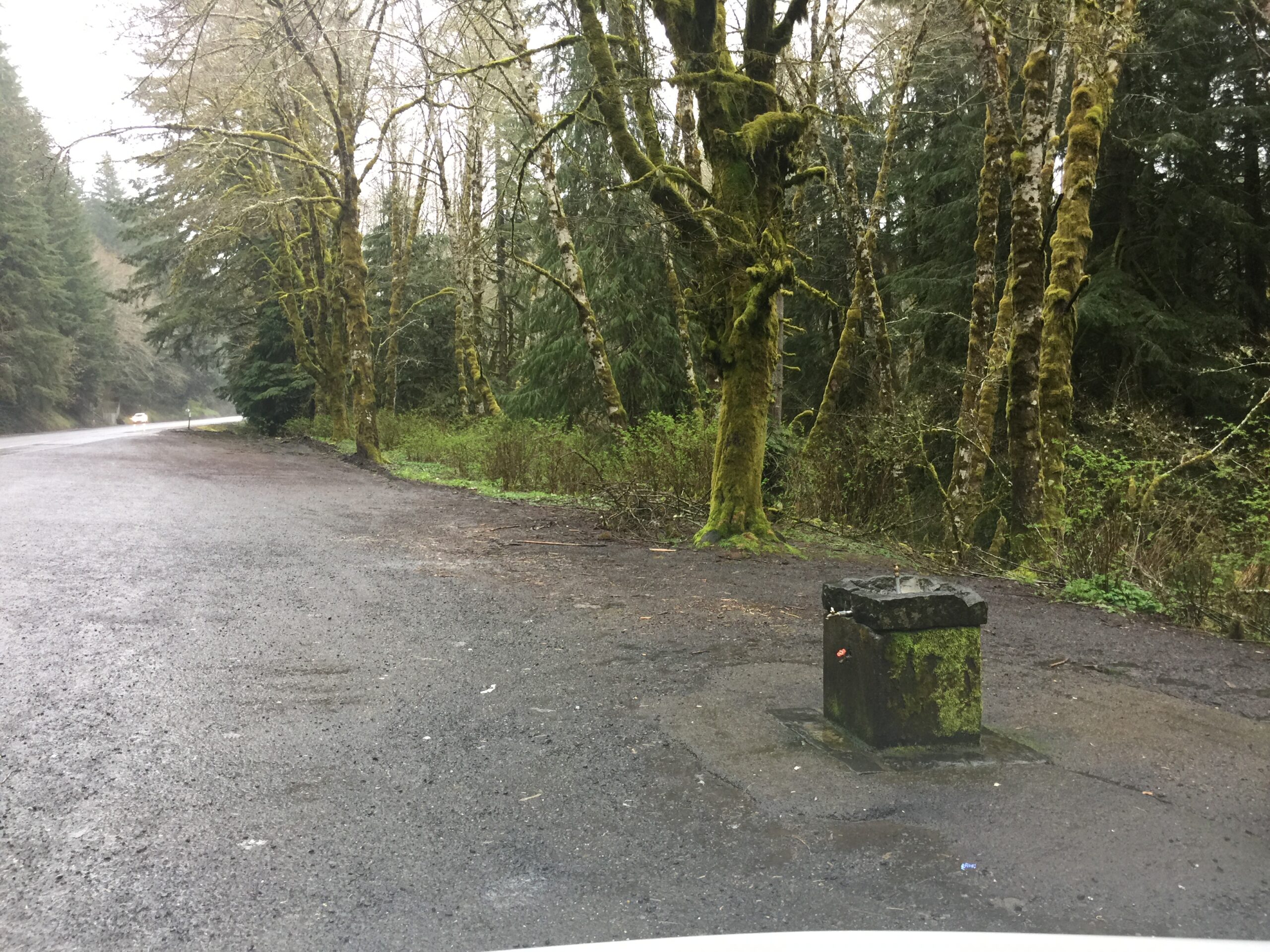
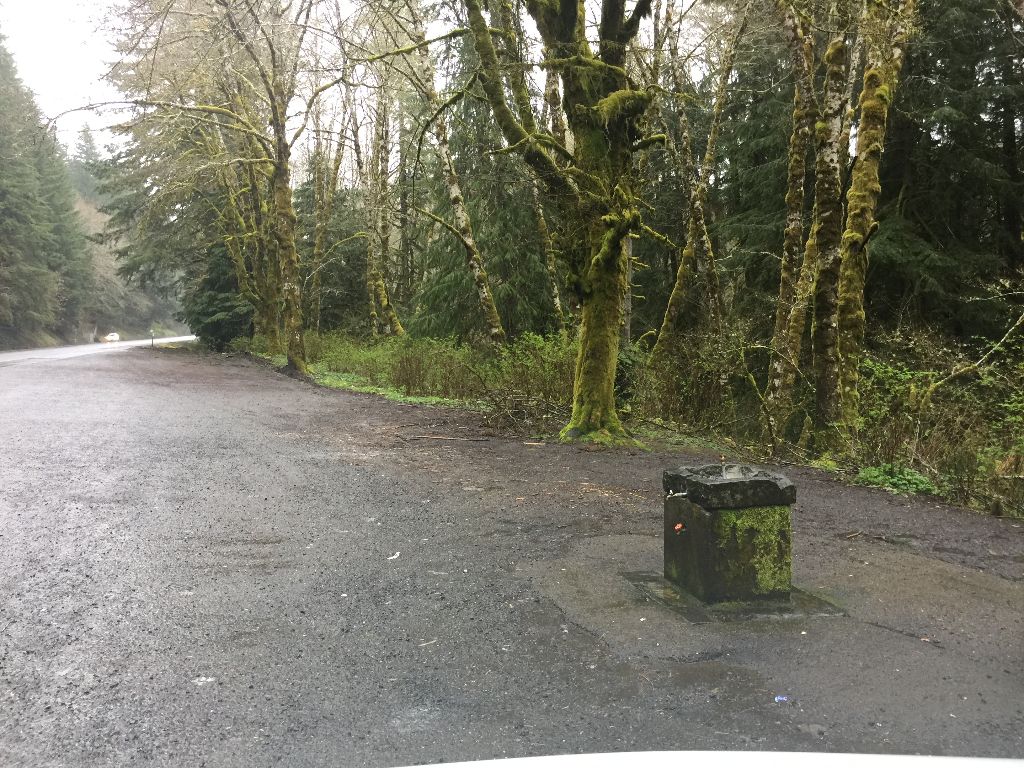
From Portland, 42 miles west on Hwy 26 towards the coast, near mile marker 28. Blue signs saying, “Drinking Water”. Fountains and faucets on both sides of the road within hundreds of feet of one another. If coming from Portland, first of two sources will be located on the right side of the road. First of two sources on the right if you are coming from the coast as well. I read a chat mentioning that the water was tested and it was some of the best they have seen. I have yet to test it my self so don’t take my word for it. As soon as I can afford the equipment I will test and update the entry. My personal body test, tells me it tastes and feels great.
Very excited to head to this Spring this weekend!! Went to the one in Wilsonville last weekend but it was dried up. Hopefully this Spring is still golden!!
I’ve been getting water here for several months now & so glad to find some information about it! I’m wondering if anyone has had it tested for Lithium content. I know Lithia Springs in Ashland has Lithium in their water as well as Bagby hotsprings. I was hoping to find a closer source to where I live.
Moved up to this area from northern CA and was worried I wouldn’t have good raw water within a fairly easy distance. Glad I found this site and this spring is great. Easy access, quick flowing and the water tastes great.
~E
I have been enjoying this water for many years but I know no history of it. Does anyone know the history of the fountains? When were they opened? Who founded them? Do they have a name?
They were made during the great depression era by the civilian conservation corps, the group organized by president Roosevelt who also happened to build Timberline lodge. They simply tapped into the already existing spring running through a clay deposit and made the two fountains.
I have been going threre and collecting water for a few months and love it. I have started a site dedicated to information about this spring. I would love any information that anyone has and I will do frequent update when I get new info. http://www.sunsetspring.com
“This blog is open to invited readers only https://www.sunsetspring.com/It doesn’t look like you have been invited to read this blog. If you think this is a mistake, you might want to contact the blog author and request an invitation.”
We bought a full report on the water quality at this spring – tested at a reputable lab. I hope the tables align okay, after my cut and paste… Results are as follows (MCL is Maximum Contaminant Level as designated by USEPA):
Now July 6th. We have made about 3 trips to collect water. Still great and we built up a large supply of glass jugs, car boys, wine bottles, etc. Bought a Berkey thinking we could save a little time/gas driving to get water but although the Berkey water is good and makes a huge difference (especially since we are using the fluoride filters, Bad Washington) we have decided that the trip is worth it and we will only use the Berkey as backup between trips.
Been to this spring a couple of times in the past few weeks. It is absolutely Delicious!! I generally fill about 12 regular green wine bottles and four Magnum green wine bottles and that lasts us for the week. I'm going to find a glass car boy soon so I won't have to come back on a weekly basis, but it's a pretty drive and definitely worth it!
Went to the spring today 5/16/2010 for the first time. Water tasted different from the tap but I soon got used to it. My wife and I drank it all day long as we spent the day at the beach. We picked up about 15 gallons to take home with us and plan on enjoying the fresh water for the next few weeks and hope to go back for more when we run out. The eastern faucet did not have a handle so I suggest anyone going to bring a leatherman tool or regular wrench just in case someone tightens down the faucet too much. Very easy to find and you will see the blue “Drinking Water” sign just past the 30 mile marker sign and the springs are closer to the 29 mile marker. So far so good, I will post again if my opinion changes about the water but for now I say it is great!
I fill 4 5 gallon jugs every 3 weeks at this spring. Have been doing this for over 3 years now. This is the BEST spring water I have tasted. It makes the best Tea and coffee and I cook w/ it exclusively.
Gloria,
I store three carboys full of water for a few weeks at a time. I think there are two main concerns. The first is that you want to try to keep it as cool as possible. Not always easy in the summer, but doesn’t have to be refrigerated or anything. The second is sunlight. If there were anything in there that could grow, it would need a little heat and sunlight to do so. So keep it cool and shaded, and you should be fine for a while. If you keep it for long periods of time, just give it a quick sniff test and that should tell you what you need to know…
If the Spout is vandalized, cannot you use the water flowing out of the white pipe located to the right? That water is the same water coming out of the spout correct?
Storing water for 3 weeks is no problem as long as you do it properly. Keep it away from light, and heat. Just store it in a 5 gallon jug and put it in the closet in an air conditioned house.
On the east spring faucet you can see the spring head about 15 yards from the spigot. I have not found the spring from the western faucet, but it may be piped from the same source. Since the eastern faucet is closer to the source (and uphill side of the highway), this is the one I choose to fill from. If coming from Portland, the spring is 11 miles from the nearby tunnel and 6 miles from the Washington county line.
TDS and temperature meter is the only testing equipment I have and the results are reflected above. I unfortunately don't have the means to do pH testing.
Drinking pure spring water is one of the most important things we can do for our health. Our bodies are over 99% water at the molecular level, so water affects every aspect of our biology. Yet, not all water is created equal. Almost all the bottled spring water available is pasteurized for shelf stability, which neutralizes many of the powerful health benefits such as increased hydrogen, healthy probiotics, and crystalline structure. For more about why unprocessed spring water is the best water to drink, read this.
The best way to guarantee you are getting real unprocessed spring water is to collect it yourself. This is a short and simple guide filled with information about how to gather spring water. We will cover how to find a spring, how to collect the water, how to honor the spring, how to store the water properly and other tips.
FindASpring.org is the best resource for locating a spring near you. However, not all springs are on the map. First, check the map to see if there is a spring in your local area. If there is, look at the reviews and comments. Has anyone shared helpful information about flow rate or posted a water test result? Is the spring in a pristine area? Do a bit of research and make sure the spring is safe to drink from. If you have any doubt about the purity, don’t risk it and get a water test, HERE. If you don’t see a spring on the map in your area, there still might be some that aren’t listed yet. First, ask the older generation who have lived in your area a long time if they know. You can also ask people in your community who might already get spring water such as people at a health food store or at a farmers market. Another great option is to view A US forest service map, where many springs have been marked. You can view these maps through the Gaia GPS or All Trails hiking apps on your phone. The map overlay you want is USGS Topo. Not all are easily accessible or ideal for drinking, but some are and it can be a fun adventure to find them. We have found over half a dozen great springs this way.
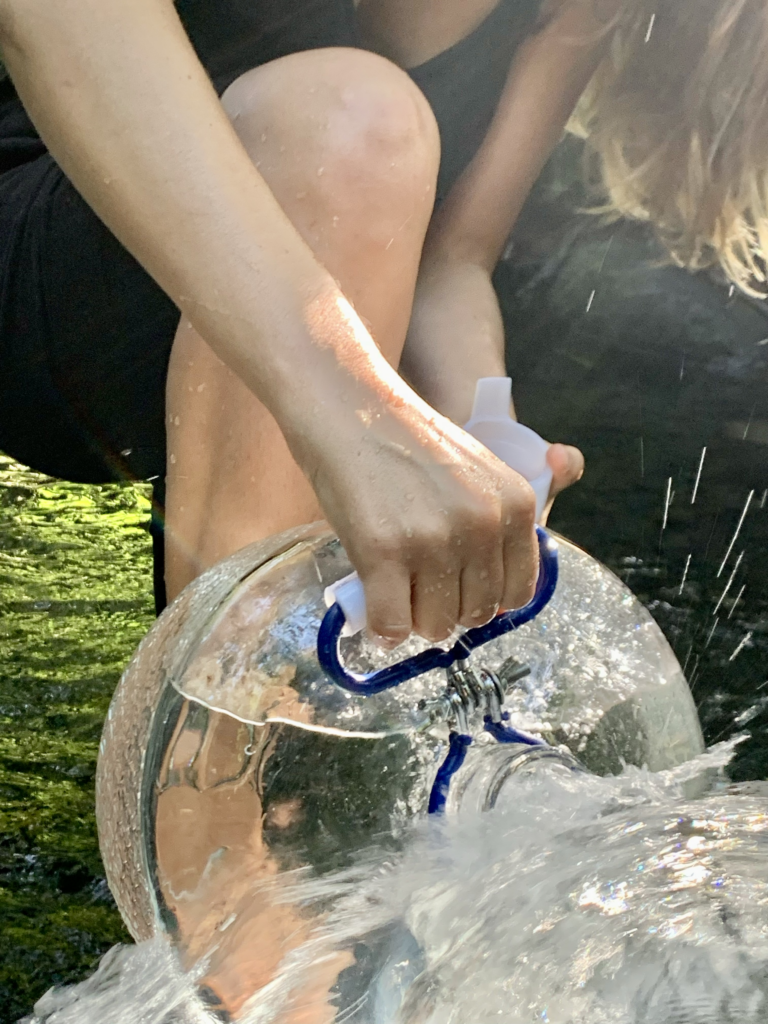
Once you’ve found your spring, figure out how you are going to gather the water. Is it right on the side of the road and easy to access or do you have to hike to it? We recommend storing spring water in glass instead of plastic to preserve the purity of the water. It is better for the environment, your body, and the water. Even BPA free plastic has toxic chemicals that can leach into water and cause health issues. If you do want to use plastic for safety reasons when filling at the spring, we recommend transferring the water to glass as soon as possible. FindASpring is sponsored by Alive Waters, which offers beautiful reusable glass. They have a 2.5 gallon option, which is a convenient size for carrying that isn’t too heavy. They also sell handles that you can use to transport the jugs even more easily. If you have to hike to access the spring, we recommend putting the water jugs into an extra large backpack to hike the water out with ease. We use Osprey packs that hold 2 jugs each. You can also use a wheelbarrow or even a stroller depending on how easy a walk it is.
Filling 2.5 Gallon Alive Waters Jug
When you get to the spring, remember to first give back before you take. Springs are considered sacred in indigenous cultures around the world for their life giving water and also as a connection to the inner earth. A powerful and simple way to give back is to clean up. Is there any trash that needs to be collected? Could you move any dead leaves or sticks to improve the flow rate? Show up in service. Some other wonderful ways to give is with a moment of expressing verbal gratitude, singing songs to the water, offering the water an ethically sourced crystal, a feather, or some other physical gift. Flowers are a popular and beautiful thing to offer, but please be careful to source organic ones as most flowers from the store are sprayed with pesticides and can be toxic to put near a spring. Also, flowers can attract bugs as they decay, so it can be best to offer them to the flowing water directly or a little downstream from the spring head.
When gathering the water, fill the jug as close to the spring head as possible, never gather downstream. Be very careful as wet glass is extremely slippery. Make sure the lid is securely fastened. When transporting the spring water home, the jugs can sometimes slide around the car. Secure them in place or wrap them with towels or something so they don’t crash into each other.
How you store your spring water is essential. It is not pasteurized like spring water from the store, so it will start growing algae if left in direct sunlight. This is good because it means it’s alive! If the water you drink can’t even support the most basic life forms, how do you think it will support your body? Store your water in a cool, dark place such as a dark corner, pantry or closet. The fridge is ideal if you have room. Some people prefer to filter their water through a Berkey filter before drinking, but if the spring is pure, it’s not necessary. We drink our spring water completely unfiltered.
How long the water stays good for depends on how cold a temperature it’s stored at. Spring water is best fresh. We personally do not prefer to drink spring water past 2 weeks old. However, we know other people that will drink it at a month old. It’s great to get in a rhythm where you know how long the water lasts you and put your collection day on the calendar in advance.
I believe that water is calling us to reconnect with her in the deepest way, to gather our own water. Just like our ancestors did. Our ancestors didn’t have fancy water machines. They also didn’t create villages or settle where there was no water. Water was revered as the center of the community and the nodal point around which life could spiral out and take root.
Here’s to restoring the sacred connection with the waters of life.
Written by Dakota Chanel. Water Priestess and Ceremonialist. DakotaChanel.com
Do you have info you'd like to add to the main spring description or perhaps a more accurate gps coordinate?
Please start by making a comment on this spring's page with any additional info, or something that you feel should be changed to reflect more accurate data. After your comment is liked by enough community members, this will validate the improved information.
Please notify us if an update with enough likes hasn't been updated in the description yet.
Please note:
This action will also remove this member from your connections and send a report to the site admin.
Please allow a few minutes for this process to complete.

 Chris
Chris
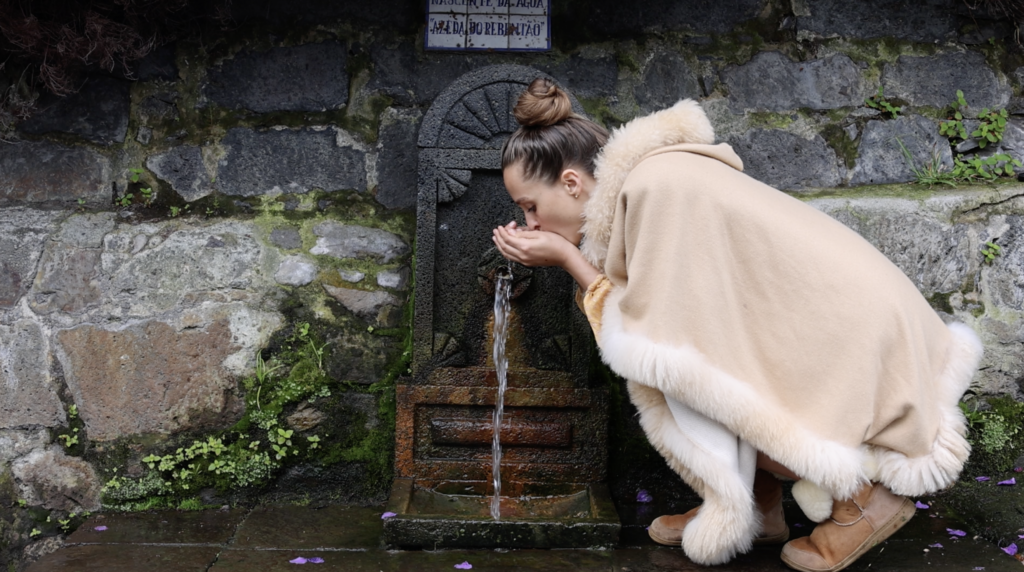

The water flows continuously and is delicious and feels great to my body. Couldn’t be happier with it.
Very excited to head to this Spring this weekend!! Went to the one in Wilsonville last weekend but it was dried up. Hopefully this Spring is still golden!!
I’ve been getting water here for several months now & so glad to find some information about it! I’m wondering if anyone has had it tested for Lithium content. I know Lithia Springs in Ashland has Lithium in their water as well as Bagby hotsprings. I was hoping to find a closer source to where I live.
Moved up to this area from northern CA and was worried I wouldn’t have good raw water within a fairly easy distance. Glad I found this site and this spring is great. Easy access, quick flowing and the water tastes great.
~E
I have been enjoying this water for many years but I know no history of it. Does anyone know the history of the fountains? When were they opened? Who founded them? Do they have a name?
They were made during the great depression era by the civilian conservation corps, the group organized by president Roosevelt who also happened to build Timberline lodge. They simply tapped into the already existing spring running through a clay deposit and made the two fountains.
I have been going threre and collecting water for a few months and love it. I have started a site dedicated to information about this spring. I would love any information that anyone has and I will do frequent update when I get new info. http://www.sunsetspring.com
I dismantled the site- not enough interest to keep it up. Sorry.
“This blog is open to invited readers only
https://www.sunsetspring.com/It doesn’t look like you have been invited to read this blog. If you think this is a mistake, you might want to contact the blog author and request an invitation.”
Has anyone tested this water for aluminum, barium, etc…?
https://www.geoengineeringwatch.org/
Do you have to filter this water?
No, we drink it straight and have been doing so for at least five months, with never a problem. It’s the best water you’ll find.
We bought a full report on the water quality at this spring – tested at a reputable lab. I hope the tables align okay, after my cut and paste… Results are as follows (MCL is Maximum Contaminant Level as designated by USEPA):
__________________________________________________________________
Parameter MCL(mg/L) Result(mg/L)
__________________________________________________________________
Total Coliform Bacteria <1/100ml (absent) 0/100ml (absent)
E. Coli Bacteria <1/100ml (absent) 0/100ml (absent)
Iron 0.30 <0.03
Manganese 0.05 <0.01
Lead 0.010 <0.001
Mercury 0.002 <0.0002
Sodium 50.0 4.60
Arsenic 0.010 = greater than < = less than
mg/L = ppm (parts per million)
Remarks:
All parameters tested meet the requirements established by the USEPA for potable water.
Note: Actual pH measurement may be slightly lower or higher than result reported
due to transit time of sample
Note: Report is intended to be used for informational purposes only and should not
be used for regulatory and/or legal purposes.
Report Date: November 15, 2010
Analysis: Pesticides/PCB’s
Parameter/Method EPA 505 MDL (ug/L) Result (ug/L)
________________________________________________________________________
PCB 1262 0.190 nd
PCB 1260 0.160 nd
PCB 1254 0.110 nd
PCB 1248 0.089 nd
PCB 1242 0.140 nd
PCB 1232 0.170 nd
PCB 1221 0.790 nd
PCB 1061 0.050 nd
a-BHC 0.001 nd
b-BHC 0.001 nd
g-BHC 0.001 nd
alachlor 0.160 nd
aldrin 0.002 nd
atrazine 0.260 nd
dieldrin 0.008 nd
endrin 0.027 nd
heptachlor 0.001 nd
heptachlor epox 0.002 nd
hexachlorobenzene 0.001 nd
hexachlorocyclopentadiene 0.006 nd
lindane 0.001 nd
methoxychlor 0.310 nd
simazine 0.870 nd
c-nonachlor 0.009 nd
t-nonachlor 0.007 nd
DDD 0.210 nd
DDT 0.170 nd
DDE 0.130 nd
endosulfan I 0.180 nd
endosulfan II 0.210 nd
endrinaldehyde 0.170 nd
endosulfan sulfate 0.260 nd
chlordane 0.100 nd
toxaphene 0.780 nd
________________________________________________________________________
MCL = Maximum Contaminant Level MDL = Minimum Detection Level
nd = none detected ug/L = ppb (parts per billion) * – Closest Match
Report Date: November 15, 2010
Analysis: Volatile Organic Compounds
Parameter/Method MCL MDL Result
VOC/EPA 524.2 (ug/L) (ug/L) (ug/L)
______________________________________________________________________
Acetone 0.500 nd
Acrylontrile 0.500 nd
Allyl Chloride 0.500 nd
2-Butanone 0.500 nd
Carbon Disulfide 0.500 nd
Chloroacetontrile 0.500 nd
Trans-1,2-Dichloroethene 0.500 nd
1,1-Dichloropropanone 0.500 nd
Diethylether 0.500 nd
Ethyl Methacrylate 0.500 nd
Hexachloroethane 0.500 nd
2-Hexanone 0.500 nd
Methacrylonitrile 0.500 nd
Methylacrylate 0.500 nd
Methyliodide 0.500 nd
Methylmethacrylate 0.500 nd
4-Methyl-2-Pentanone 0.500 nd
Nitrobenzene 0.500 nd
2-Nitropropane 0.500 nd
Pentachloroethane 0.500 nd
Propionitrile 0.500 nd
1-Chlorobutane 0.500 nd
Dichloroflouromethane 0.500 nd
Chloromethane 0.500 nd
Vinyl Chloride 2 0.500 nd
Bromomethane 0.500 nd
Chloroethane 0.500 nd
Trichlorofluoromethane 0.500 nd
__________________________________________________________________
Page 3-1
Parameter/Method MCL MDL Result
VOC/EPA 524.2 (ug/L) (ug/L) (ug/L)
______________________________________________________________________
1,1 Dichloroethene 2 0.500 nd
Methylene Chloride 3 0.500 2.55ppb
trans-1,2-Dichloroethene 100 0.500 nd
1,1 Dichloroethane 50 0.500 nd
2,2 Dichloropropane 0.500 nd
cis-1,2 Dichloroethene 70 0.500 nd
Chloroform 0.500 nd
Bromochloromethane 0.500 nd
1,1,1 Trichloroethane 30 0.500 nd
1,1 Dichloropropene 0.500 nd
Carbon Tetrachloride 2 0.500 nd
Benzene 1 0.500 nd
1,2 Dichloroethane 2 0.500 nd
Trichloroethene 1 0.500 nd
1,2 Dichloropropane 5 0.500 nd
Bromodichloromethane 0.500 nd
Dibromomethane 0.500 nd
cis-1,3 Dichloropropene 0.500 nd
Toluene 1000 0.500 nd
trans-1,3 Dichloropropene 0.500 nd
1,1,2 Trichloroethane 3 0.500 nd
Tetrachloroethene 1 0.500 nd
1,3 Dichloropropane 0.500 nd
Dibromochloromethane 0.500 nd
1,2 Dibromomethane 0.500 nd
Chlorobenzene 50 0.500 nd
Ethylbenzene 700 0.500 nd
1,1,1,2 Tetrachloroethane 1 0.500 nd
m,p-Xylene 0.500 nd
o-Xylene 0.500 nd
Styrene 100 0.500 nd
Methyl Tertiary Butyl Ether (MTBE) 70 0.500 nd
Isopropylbenzene 0.500 nd
Bromoform 0.500 nd
1,1,2,2 Tetrachloroethane 1 0.500 nd
1,2,3 Trichloropropane 0.500 nd
n-Propylbenzene 0.500 nd
Bromobenzene 0.500 nd
1,3,5 Trimethylbenzene 0.500 nd
__________________________________________________________________
Page 3-2
Parameter/Method MCL MDL Result
VOC/EPA 524.2 (ug/L) (ug/L) (ug/L)
__________________________________________________________________
Chlorotoluene-2 0.500 nd
Chlorotoluene-4 0.500 nd
tert-Butylbenzene 0.500 nd
1,2,4 Trimethylbenzene 0.500 nd
sec-Butylbenzene 0.500 nd
p-Isopropyltoluene 0.500 nd
1,3 Dichlorobenzene 600 0.500 nd
1,4 Dichlorobenzene 75 0.500 nd
n-Butylbenzene 0.500 nd
1,2 Dichlorobenzene 600 0.500 nd
1,2 Dibromo-3-Chloropropane 0.500 nd
1,2,4 Trichlorobenzene 9 0.500 nd
Hexachlorobutadione 0.500 nd
Naphthalene 300 0.500 nd
Hexane 0.500 2.69ppb
1,2,3 Trichlorobenzene 0.500 nd
Total Xylenes 1000 0.500 nd
__________________________________________________________________
MCL = Maximum Contaminant Level MDL = Minimum Detection Level
nd = none detected ug/L = ppb (parts per billion) ** = Exceeds USEPA limits
Now July 6th. We have made about 3 trips to collect water. Still great and we built up a large supply of glass jugs, car boys, wine bottles, etc. Bought a Berkey thinking we could save a little time/gas driving to get water but although the Berkey water is good and makes a huge difference (especially since we are using the fluoride filters, Bad Washington) we have decided that the trip is worth it and we will only use the Berkey as backup between trips.
Been to this spring a couple of times in the past few weeks. It is absolutely Delicious!! I generally fill about 12 regular green wine bottles and four Magnum green wine bottles and that lasts us for the week. I'm going to find a glass car boy soon so I won't have to come back on a weekly basis, but it's a pretty drive and definitely worth it!
Where’d you find your glass car boy?
You can find carboys at any good home brew store, but I got mine off of craig’s list.
THANKS!
Went to the spring today 5/16/2010 for the first time. Water tasted different from the tap but I soon got used to it. My wife and I drank it all day long as we spent the day at the beach. We picked up about 15 gallons to take home with us and plan on enjoying the fresh water for the next few weeks and hope to go back for more when we run out. The eastern faucet did not have a handle so I suggest anyone going to bring a leatherman tool or regular wrench just in case someone tightens down the faucet too much. Very easy to find and you will see the blue “Drinking Water” sign just past the 30 mile marker sign and the springs are closer to the 29 mile marker. So far so good, I will post again if my opinion changes about the water but for now I say it is great!
I fill 4 5 gallon jugs every 3 weeks at this spring. Have been doing this for over 3 years now. This is the BEST spring water I have tasted. It makes the best Tea and coffee and I cook w/ it exclusively.
Would there be danger in the water “going bad” i.e. mold etc storing it for 3 weeks? thanks.
Gloria,
I store three carboys full of water for a few weeks at a time. I think there are two main concerns. The first is that you want to try to keep it as cool as possible. Not always easy in the summer, but doesn’t have to be refrigerated or anything. The second is sunlight. If there were anything in there that could grow, it would need a little heat and sunlight to do so. So keep it cool and shaded, and you should be fine for a while. If you keep it for long periods of time, just give it a quick sniff test and that should tell you what you need to know…
Hi Cindy,
If the Spout is vandalized, cannot you use the water flowing out of the white pipe located to the right? That water is the same water coming out of the spout correct?
Storing water for 3 weeks is no problem as long as you do it properly. Keep it away from light, and heat. Just store it in a 5 gallon jug and put it in the closet in an air conditioned house.
I would like to see how that test turned out. Very interested. Thanks
On the east spring faucet you can see the spring head about 15 yards from the spigot. I have not found the spring from the western faucet, but it may be piped from the same source. Since the eastern faucet is closer to the source (and uphill side of the highway), this is the one I choose to fill from. If coming from Portland, the spring is 11 miles from the nearby tunnel and 6 miles from the Washington county line.
thanks for testing it bro, i no longer live in that area but am stoked to have the info for the next time i hit it up.
Has this been tested yet?
Bought some equipment on ebay. I'll go test this baby when it arrives so we can get some more data.
All is needs now is a urinal and it would be a perfect rest stop. I wonder if there are any REAL water sources in the mountains away from traffic???
TDS and temperature meter is the only testing equipment I have and the results are reflected above. I unfortunately don't have the means to do pH testing.